This is a continuation of my previous post. Please read the previous posts here, Part 1, Part 2, Part 3, Part 4, Part 5 , Part 6 , Part 7 ,Part 8 and Part 9
The rest of the time in India was great and what made it even better was the fact that I had an awesome boyfriend by then who loved me so much. We both were so in love at that stage that he used to sleep only 4 hours to talk to me and I on the other hand was sleeping talking to him on the phone every night. His was the first voice I heard every morning. The time difference really was killing us.
I really don’t know what happens between two people when they fall in love. I know an old saying , ” When you in love, you don’t feel like eating or sleeping” but it was just the opposite for me. I was sleeping well and I was definitely eating well. But I had this wonderful fuzzy feeling that left me feeling giddily happy and I enjoyed talking and sharing with AS as our conversation flowed so easily and at the same time I was also very comfortable being silent with him. There was a warm flow of energy between us even though we were miles apart and I felt connected with him even from such a distance but at the same time I wanted to be close to him. Some days I used to get frustrated that it would be 10 more days until I saw him again. I so wanted to see him in front of me, I wanted to hold him and hug him but he was in LA some 13000 km away on opposite side of the globe.
Well, from India, we went to Nepal and started our trip to across Illam, Mirik, Jhapa, Itahari, Kakarvita and surrounding places. I have to say that they were just awesome. Illam is in the far east of Nepal and really beautiful. It is famous for the scenery and landscapes, tea production, and diverse agricultural economy.
 It took us a while to get there going around the winding hills but was it worth the effort. From the top of the hill, I could see endless hills covered with tea plantations and it was much better than any tea garden I had seen before.

Iilam is situated on the foothills of Mount Kanchanjunga, the third highest peak in the world. Illam is adorned with an almost limitless range of lush-green tea gardens. The rolling hills covered with tea leaves are simply majestic. The thick white fogs alternatively descend to veil the gardens and then suddenly vanish. Greenery prevails all over the hills of Illam all around the year.
 In 1861 Col Gajraj Singh Thapa, the governor of Illam district and a close relative of Prime Minister Jung Bahadur Rana, initiated the planting of tea in Illam with seeds that had been given as a gift by the Chinese Emperor.

Illam also offers an excellent getaway from city life for romantic sunrise and sunset, a brisk walk in the tea garden, tranquil picnic and sightseeing spots, short treks along gentle slopes or a trudge into the nearby woods. If spiritual instinct calls there are several holy sites one can visit in and around the area.

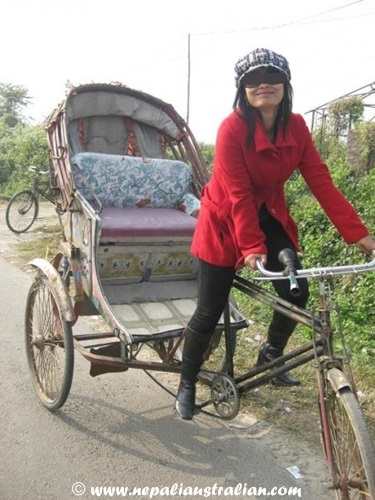
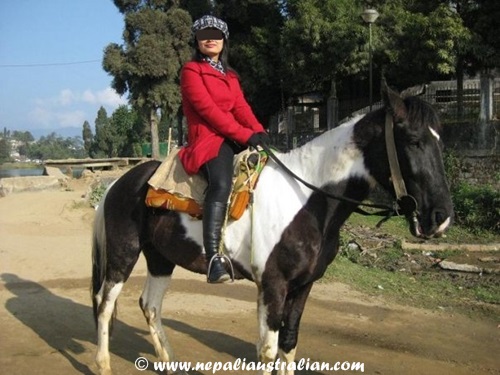
I also got to ride a horse and a rickshaw (a 2-wheeled passenger cart) and enjoyed more time with my parents.
 One evening we were back at the hotel after our tour when my dad’s phone rang. Everything seemed so perfect and suddenly I was brought back to reality. One of my aunts called my dad to talk about a possible husband for me. I heard them talking on the phone but I didn’t want to say anything. I messaged AS “Please call me as I need to talk to you about something important.”
He called me straight away. I went outside to answer making sure my parents couldn’t hear my conversation.
AS: Hello my love, how are you?
Me: I think I am not OK.
AS: What’s wrong?
Me: I am OK. It’s just that I think I need to tell my parents about us. They are still looking for a husband for me. I know it is still too early but I can’t meet anyone when I get back to Kathmandu.
AS: I know
Me: What to do?
AS: Why don’t you tell your parents and I will tell mine too.
Me: You sure about this?
AS: Of course. Why are you worried? I know this is what I want. I hope you think the same.
Me: I do too but I don’t want to rush into any decision.
AS: I know.
Me: Also promise me one thing. I know my parents will be OK with us but I am not sure about yours so if they say anything at all, you tell me right away.
AS: I know they will be fine, don’t worry.
Me: I am saying this just in case. I definitely don’t want to continue if anyone objects to our being together. (I couldn’t believe I was saying these words but I wanted to make sure both our families are happy if we are going ahead with our relationship.)
AS: Why are you talking like that, don’t worry everything will be fine.
Me: I really hope so. I am so scared and worried. You know that I love you so much but still I don’t want to make either family unhappy. I hope you understand what I mean.
AS: I am sure we will be fine. We are from the same cast so my grandparents will be OK too. You are an educated, good-looking, nice girl so I don’t see a reason for any objections.
I really wanted to believe in AS’s words but at the same time, I was worried. It seemed like everything was happening so quickly. I hadn’t even met him yet and here we were talking about telling our parents about our relationship which was just a week old.
We talked some more and he did his best to assure me that things will be fine and not to worry. He said he would talk to his parents and tell them about us so they would stop looking for a girl for him.
By the time I hung up, I felt a bit better and more hopeful.
Some of you might be thinking why it is so important to me that both of our family agree to our relationship. I have always believed in marriage and I always knew that marriage especially in Nepal, is not just between two individuals but it is between two families. Even though I spent so much time overseas, I knew that it is important for me to make sure my parents are happy with my decision. Don’t get me wrong, my parents are open-minded modern people who were OK to send their teenage daughter by herself to Australia. However, at the same time when it comes to marriage, I was a bit worried. I knew it would be OK but still I had 0.01% doubt.
On the other hand, I didn’t know anything about AS’s family. I had met one of his brothers and his mum but didn’t really know them. I was more worried about the reaction from his family more than from mine when they learnt about us.
To be honest, I didn’t have any plan about what I would do if any of our family had a problem with our decision but I didn’t want to think about it at that moment. All I wanted to believe was that everything would be fine. I had a zillion things in my mind when I went to bed that night.
The next morning I woke up earlier than usual. The first thing I did was talk to AS to see how things were going. He told me that he was going to talk to her parents that day. So I decided to talk to my parents the same day too.
We were having breakfast at the hotel that morning. My dad and mum seemed to be in a good mood so I decided that is the moment.
Me: I need to talk to you about something.
Dad: Sure. What’s wrong?
Me: Nothing really wrong. It is about the marriage.
Mum: Don’t tell us now you have changed your mind about it again. We have had this conversation before. (I have told you in my previous posts, there was a time when I was planning not to marry at all, so I could understand why mum was worried.)
Me: No, no. I am going to get married whenever you guys want but it is just there is someone.
Mum: Who?
Me; There is this friend from school, AS who likes me. I like him too. So I want you to stop looking for a guy for me.
Mum: Does that mean you will marry him?
Me; I don’t know yet. I haven’t met him for more than 6 months. He will be coming to Kathmandu in a few days.
Dad: What does he do?
Me: He studied with me in school. He is an Engineer and currently living in LA.
Dad: Where is from? What is his parents’ name?
Me; I think he is from Kathmandu and I think his family is from there too but I am not too sure. I don’t know his family and their name. All I know is he has 2 brothers.
Mum: Do I know him?
Me: May be. He has come to our place many times when we were in school.
I didn’t have his picture with me but when I described him, she seemed to recall something.
Mum: Is he the one you are talking to on the phone every day?
Me: Yes.
Dad: Look, all we want is you to be happy. I know you have made you own decisions for a while now so if you are OK with him, we are fine. Get him to meet us when he comes to Kathmandu.
I was relieved when I heard his words. I just wished the same thing was happening on AS’s side.
I promised my parents that they would like him and he is a great person. In addition, I would ask his parents’ name and his family history when I talked to AS next.
We talked some more about AS and I tried my best to portray him as a most desirable son-in-law they could ever get. I messaged AS to call me when he could. I got a message saying he was talking to his parents and will call back soon.
My heart was pounding. It seemed 50% was OK now but still there is the most important 50% that I needed to know about. That day we were going back to Kathmandu and we had a flight in the afternoon.
After packing and having lunch, I started becoming impatient and sent another message to AS. He sent me a message saying he was still on phone. It made me really scared wondering why it was taking him so long. My conversation had not been that long. My mind started to think of everything that could go wrong. I tried to control myself but it was very difficult.
Then the car came to pick us up to go to the airport and still there was no call from AS.
Finally AS called after we checked it.
AS: Hello dear!
Me: Hello. What happen? (You can see I don’t waste any time getting to the point?)
AS: Nothing happened. Did you talk to your parents?
Me: Yes. What about you? How did it go?
AS: I don’t k now.
Me: What do you mean you don’t know? Don’t leave me hanging. Seriously, what happened?
AS: They told me they have to think about it.
Me: About what?
AS: About us.
Me: What does it mean? I am going to cry now.
AS: Ohoo, don’t. Why are you so worried? They said OK. They want to see your photo and you as soon as possible. I told them, once I come to Kathmandu, you can come and visit them.
Me: And?
AS: And everything is good. You worry too much. You know that I love you and you don’t have to worry at all. Now tell me what your parents said. I have a feeling it went all well too.
Me; No, it didn’t.
AS: Why?
Me: They said they have to see you and check you out properly before they decide.
AS: Hahahaha that means it went alright. Look, it was not bad at all. Everything is fine now. You just worry for nothing.
Me: I hope it will be all fine. BTW, I need your parents name and your family background.
AS: Almost forgot. My parents asked the same question.
We continued the conversation for another 20 minutes until it was time for me to board the plane to come back to Kathmandu.
It was one amazing holiday.
More in next post. Take care everyone!
XOXO
M form nepaliaustralian
Go to Part 11
You may also like: