Category Archives: Newari Food

Update from Nepal Part 3

Skinny and photogenic

90% of the people I meet in Nepal told me that I am too skinny and I need to put on some weight. I am not underweight so I am happy with it and as you all know I try very hard with exercise and healthy food to maintain my figure but most people in Nepal have their own ideas about my weight.

IMG_2614

In the beginning I used to get annoyed about it but now I am so used to it that I ignored all these comments with a smile :). Also if you look around Kathmandu, most gals are either similar weight like mine or even skinnier than me so I have no idea why they think I need to put on weight. I have a feeling being married is one of the factor.

Anyway I am learning to just ignore and concentrate in good eating habit no matter what people say. Also AS is on my side telling me I am OK and we just need to concentrate on being healthy. I am very happy to have such a wonderful hubby who understands me so well. But I think he has an ulterior motive as well. He doesn’t want me gaining weight and buying more clothes as I won’t fit into my current ones then 🙂

Most of the people especially from AS’s side has seen me only during the wedding. That time I was a bride so I was fully made up in the traditional attire. After the wedding, lot of his relatives added me on their Facebook. So that is the only way they have seen me in causal dresses.

Anyway, I have heard from lot of his relatives that I am photogenic. I am not sure I should take that as a compliment or not. I am just wondering because, normally I think photogenic means I look good on photo but at the back of mind I was wondering, does that mean I don’t look good in person.

Anyway I got that comment from many people so just sharing what’s on my mind here 🙂

Maghe Sankranti

According to Nepali calendar, it was Maghe Sankranti (1st of Magh) a few days ago.  Please click here to read more about this festival.

As I am married now, I was invited to AS’s grandparents house to celebrate the festival with my in-laws. AS missed the occasion but I was glad I was there as I got to meet all his relatives again.

As I mentioned in my post, this day we eat laddoos (sesame seeds candy ball), chaku (molasses), ghee (clarified butter), sweet potatoes, yam, khichari (mixture of rice and lentils), ginger and salt  and green leaf spinach. So a big feast was ready in the house when we got there.DSC04802DSC04800DSC04799
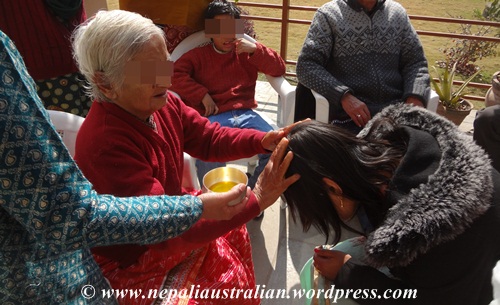
First his grandma put mustard oil on our head and blessed us then we all enjoyed the food. It was fun catching up with my new family.
DSC04779

After a few days of Magh 1, AS’s Mama (Mum’s brother) also invited us for Maghe Sankranti. In Newari culture normally, daughter’s family invites SIL, daughter and their kids after the festival as nakhatya (festival invitation in newari) to celebrate the festival.

DSC04803-tile

I got to meet more family members in this function as well. As you must have guessed,there was a feast prepared which included laddoos, chaku (molasses), ghee (clarified butter), sweet potatoes, yam, khichari, green leaf spinach and many more  dishes. .

Ma fussy chu ( I am fussy)

Sometime words have two different meaning in different languages and I got caught into that recently.

The other day I was in a departmental store trying on few make-up items. The sales gal was doing her job well convincing me to buy something so in reply I said, “ Ma fussy chu ( I am fussy), so let me think about it.” But she understood completely different thing.

Fussy (pronounced Fashi ) means con in a gentle way in Nepali language. So she thought I was telling her that she tried to con me into buying something else. For a minute I didn’t understand her reply as it was out of context when she said, “Don’t worry I am telling you the truth” but after a while I understood that she thought I thought she was conning me into buying something different.

Now I think before I say something as it might have a different meaning here.

Pasni Party

While AS was here we were invited to a Pasni of one of our friends’ kid along with my parents. They live in Sydney near us but they came here to host the function like my brother. It was nice to go to this function and enjoy Nepali way of socialising. I met a few friends and relatives in this function because in Nepal, somehow everyone seems to be related. 🙂

4994_10151470613096833_1587926127_n

Wedding party experience

I am writing this as my own experience and have no intention to disrespect any caste.

As I have told you in my post here, Nepal is a country of four castes and thirty six sub castes which means all of these castes have their own tradition and rituals.

I am from Newar caste and in our culture wedding parties goes till late at night. It is common to see Newari party starting around 6 pm and finish at 12 midnight but other castes like chhetri or bhaunu may have wedding parties that start in the afternoon and finish a bit early like 6-7pm.

One of my friends (a chherti by caste)  had invited me for his sister’s wedding. He asked me if I needed a physical invitation card but I said it’s OK as I didn’t want to bother him. So I went to the party hall where he had told me in that day with one of my cousins.

When we reach the hall, the hall was almost empty so I thought either I mix up the day or the venue. But as I entered, I saw my friend. It was 7 pm at most but there were only a few people left there. Even the bride and groom had left as they had to travel few hours to reach their home.

He informed us that the party was almost over. I was a bit embarrassed because I didn’t know what to say. I had tried to contact him earlier to find out the details but he was unavailable as he was flying in from the US the same day. Even my mum had reminded me to check the time but I just assumed that it would be same as ours but I was so mistaken.

I was happy to meet my friends after a while but it was a bit embarrassing situation and for the first time in my life I reached a party when it was almost over.

Latest update

I am having a great time with my parents. I am spending lots of time with them talking and having a great time. We have been to many temples around Kathmandu which I will post details of later. I am really glad that I extended my 2 weeks holiday to spend with them as they are very happy to have me here and I am very happy to be here.

I still miss AS a lot but I will be seeing him soon. We talk on the phone or Skype everyday so I am happy to be in Kathmandu in my birth home.

Take care everyone till my next post.

Asthami : Dashain

Hindus all over Nepal is celebrating Maha Ashtami today, the eighth day of Dashain, by worshipping Goddess Durga.

From ritualistic aspects,  Maha Ashtami holds very important value. On this day, the fiercest embodiment of the Goddess is worshipped. Goddess Durga is believed to bestow peace, longevity and perpetual happiness on her devotees.

People also read the Durga Saptashati scriptures today. The Durga Saptashati is divine recitals consisting of 700 slokas , or verses, divided into three parts – the first relating to Maha Kali, the second to Maha Lakshmi, and the third to Maha Saraswati.

Undertaking Durgasaptashati Patha  is supposed to destroy fear and the devotee is blessed with a benevolent mind. Chanting sacred hymns of Durgasatshati is also believed to eliminate poverty and free the devotee of all the sorrows.

The Goddess Durga is described as Sarvaswarupa (the one which incorporates every kind of form), Sarveshwari (the one who observes the function of all) and is possessed of all the divine powers and attributes. Goddess Durga can destroy all the illnesses and physical maladies of her devotee. 

Goddess Durga has 108 divine names and merely remembering or chanting the holy names can remove all the sufferings and bless the devotee with wealth and prosperity. 

The divine principle of Goddess Durga is supposed to manifest in nine rupas (forms) during the auspicious period of Dashain (the auspicious period of nine divine nights) and these divine forms are deified as Navdurga (nine divine manifestations of Durga) which are ascribed these divine names:

1. Shailputri, 2. Brahmacharini, 3. Chandraghanta, 4. Kushmanda, 5. Skandamata, 6. Katyayani, 7. Kalaratri, 8. Mahagauri, 9. Siddhidatri. 


Devotees throng the various shrines of the goddess in Kathmandu Valley from early morning today to offer prayers and to sacrifice animals like goats and ducks at different temples of Bhagwati including Bhadrakali, Kalikasthan, Guheswori, Mahankaal, Taleju Bhagwati, Daskshinkali, Sankata Shova Bhagwati and Naxal Bhagwati. Blood, symbolic for its fertility, is offered to the Goddesses.

Today, sacrifices and special offerings are made at Dashainghars and Kots as well. The old palace in Basantapur Hanuman Dhoka, is active throughout the night with worships and sacrifices in almost every courtyard. In Dasain Ghar at midnight , a total of 54 buffaloes and 54 goats are sacrificed in observance of the rites. After the offering of the blood, the meat is taken home and cooked as “prasad”, or food blessed by divinity. This food is offered, in tiny leaf plates, to the household Gods, and then distributed amongst the family. Eating this food is thought to be auspicious. Appropriately enough, the night of this day is called Kal Ratri (Black Night). 

While the puja is being carried out great feasts are held in the homes of common people.

People who do not sacrifice animals offer sacrifices of various vegetables and fruits in place of animals.

Some Hindus will also be fasting this day.

In Newari culture, we eat Kuchi Bhwey to mark this day. We were invited for the feast at my cousin house.

It consists of 9 Newari dishes which are

Kuchi bhwey

Fulpati: Dashain

After Ghatasthapana, the next major excitement arrives with Fulpati, also known as Saptami, which is the seventh day of the festival. Today is Fulpati. Phool(Ful) means flower and pati means leaves and plants in Nepali. FulPati literally means flowers, leaves and plants.

On this day, in the past when the Nepal was ruled by a king, the jamara to be used by the royal family was brought from Gorkha Palace, their ancestral house. The Fulpati (jamara and the other items that are necessary for tika) is brought after a three day walk from Gorkha district which is about a hundred and sixty nine kilometres away from the valley of Kathmandu. A parade is held at Tundikhel ground in Kathmandu.


However, since 2008 when the monarchy was abolished, the two-century old tradition was changed so that the holy offering of Fulpati goes to the residence of the Prime Minister. The Prime Minister has taken over the king’s social and religious roles after the fall of the royal government. The Fulpati is brought from Gorkha to Dhading district from where six Brahmins carried it to Jamal. From Jamal, the Fulpati filled with holy water, banana stalks, jamara and sugarcane tied with red cloth to be offered to Goddess Durga, is carried by Bhramans on a decorated palanquin under a gold tipped and embroidered umbrella to the Dashain Ghar in Hanuman Dhoka. The Gurujyuko Platoon, the Nepal army, Nepal police, and high-ranking officials of Armed Police and civil service, band music, and panchebaja bands also join the Fulpati parade. While the sacred items are being placed in Hanuman Dhoka palace, there is a majestic display of the Nepalese Army along with a celebratory firing of weapons that continues for ten to fifteen minutes honouring Fulpati. Army parade in Tundikhel is watched by the President, Prime Minister and other high level dignitaries in conventional formal dress.

All government as well as private offices close down from today encouraging people to go back to their respective ancestral homes and receive blessings from Durga Bhawani as well as their elders.

According to historian Prakash Darnal, the Fulpati celebration was started during the rule of Late King Prithivi Narayan Shah, after he united the small kingdoms into one Nepal.

Though Dashain begins with Ghatasthapana, the festival gets special flavour from the day of Fulpati.

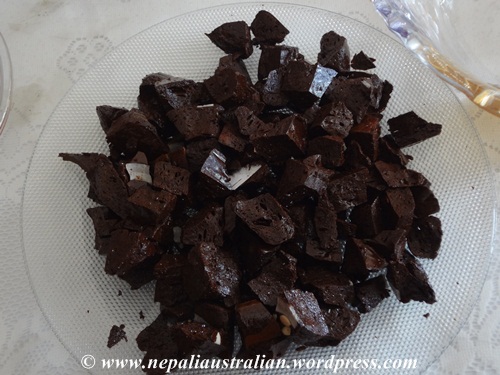
As there is not much happening in Sydney for Fulpathi, we just gather in my house and had Samay Baji. This is a newari style Bhoj that we have in Nepal during Dashain. I will write details about the Samay Baji in my next post. This it what it looks like.

The festival will continue with Maha Asthami on Monday, Nawami on Tuesday and Dashami on Wednesday.

Aloo Tama bodi (Potato with Bamboo Shoot and black eye beans)

This is one of the popular dishes in Nepali/ Newari cuisine. In Newari style Bhoj (feast) you will always find this dish.

Aloo Tama is a classic Nepali soup prepared with black eyed beans, potatoes, bamboo shoots and spices. Tama is a non-fermented bamboo shoot product. Aloo tama is well-loved comfort food cooked almost in every household throughout Nepal. The enduring popularity of this dish is that, it is extremely tasty and very appetizing mainly for its slightly sour and pungent taste. There are different way to cook this and today I am sharing my style using pressure cooker.

Ingredients

  • 1 cup bamboo shoots (preferably sour one)
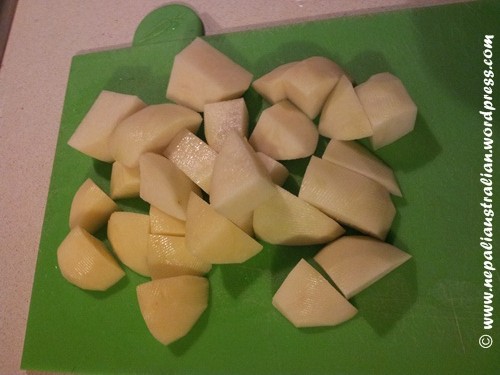
  • 4 medium potatoes, peeled, and cut into ½ inch cubes
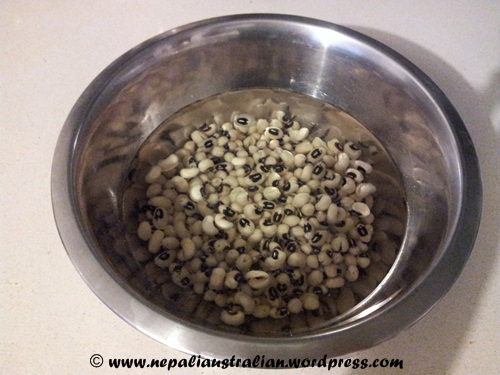
  • 1 cup black-eyed peas (soaked overnight)
  • 1 teaspoon dry cumin seeds (jira)
  • 1 medium onion, finely chopped
  • 3 red dry chilies
  • 1 teaspoon cumin powder
  • 1 teaspoon chili powder
  • 1 teaspoon garlic, minced
  • 1 teaspoon ginger, minced
  • ½ teaspoon turmeric
  • 2 medium chopped tomatoes
  • 2 tablespoons oil
  • Salt to taste
  • Lemon juice to taste

Steps

  • First of all let the black eyed beans shock in water for overnight. If you forget to soak it overnight, you can soak in hot water for few hours and it will be fine.

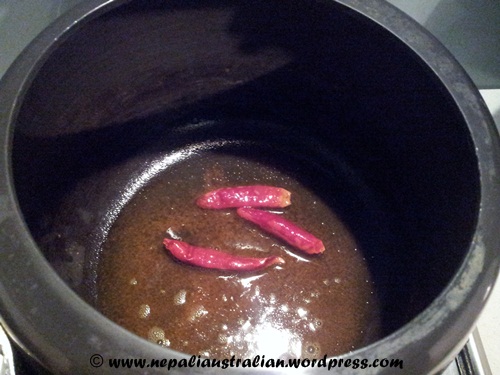
  • Heat oil in a pan. I used pressure cooker.
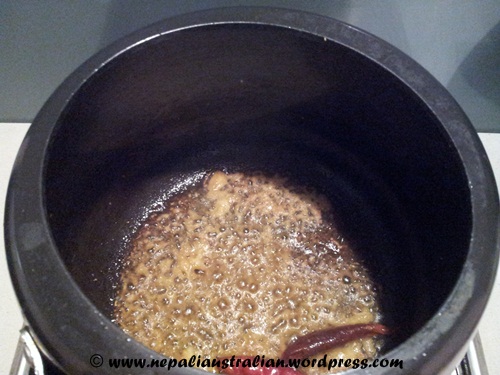
  • Add turmeric, dry cumin seeds and red chilli and fry until it is dark.

  • Then add garlic and ginger.

  • Add chopped onion and cook few minutes on low heat.

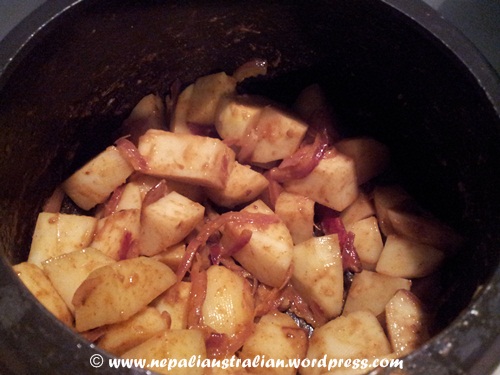
  • Add potatoes to the onion and sauté for at least 5 minutes in medium heat.

  • Add little water so that it doesn’t stick on the pan.
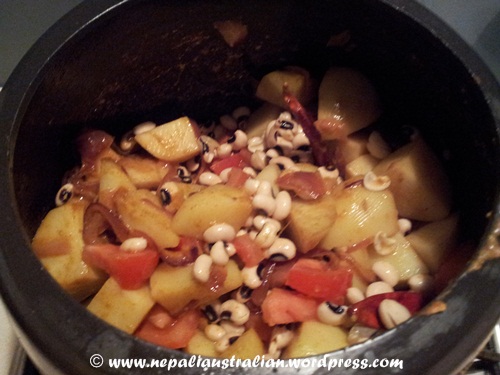
  • Add soaked beans, tomatoes and fry for few minutes.

  • Add 2 cup of water, salt, chilli powder and cover the pressure cooker and press for 6-10 whistle or until potatoes is cooked.
  • Take off the pressure cooker and let it cool down.

  • Now add bamboo shoots and 1 cup water ,cover it and let it simmer for another 10 minute or until desired consistency is reached.

  •  Taste and add lemon juice as required to make it bit sour.
  • Sever with roti or rice.

You may also like :

*Aloo dum *Aloo ko achar *Aloo chop

Aloo ko achar (Nepali style potato salad)

Aloo ko achar is a very popular Nepali potato salad which is used in most bhoj in Nepal. There are many different ways that it can be prepared. I am sharing my recipe here.

Ingredients

  • 3 medium potatoes (200gm)
  • 1 cucumber
  • 1 carrot
  • 1 Spanish onion
  • 2 Teaspoon of mustard oil
  • 1 Teaspoon turmeric powder
  • 1 Teaspoon crushed chilli flakes
  • 1/2 Teaspoon fenugreek seeds (methi)
  • 1/2 cup white sesame seeds (teel)
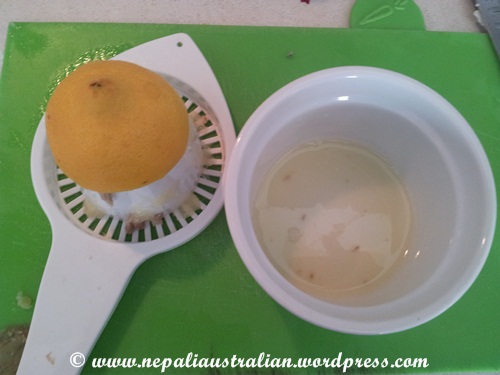
  • 1/2 cup lemon juice
  • 3 green chillies
  • A few leaves of fresh Coriander
  • Salt to taste
Fenugreek seeds (Methi)

 Steps

  • Boil potatoes, peel and chop into quarters. I use pressure cooker as it is quick and easy.

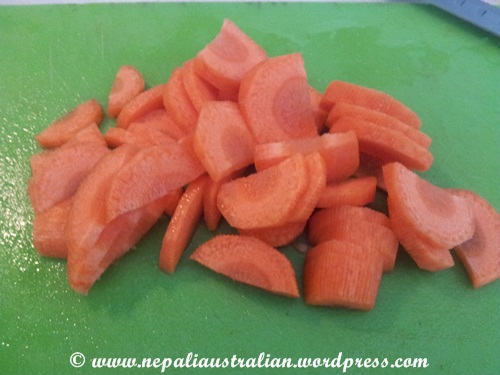
  • Cut cucumber and carrot in half moon shapes as shown in photos.

  • Finely chop Spanish onion, green chillies and coriander leaves.

  • Roast sesame seeds (Teel) on a pan until it turns light brown and starts crackling. Make sure to stir regularly so it doesn’t burn.

  • Place it in the blender with half a cup of water to make a fine paste. Alternatively grind it into a fine powder in the grinder and mix with half cup of water.

  • Put the potatoes, cumber, carrot, onion, coriander and green chilli into a big bow. Add the sesame paste, lemon juice and salt.

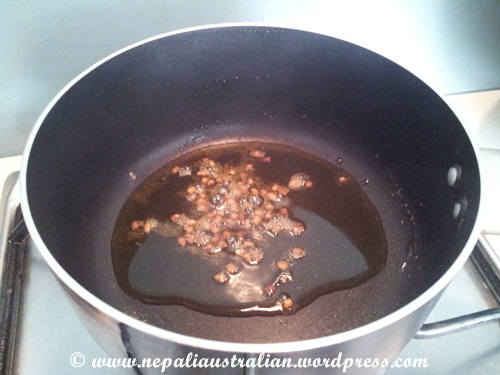
  • Heat a frying pan over medium heat and add mustard oil. When the oil gets heated and you start to see smoke add the fenugreek seeds. Wait till it goes dark brown and add chilli flakes, turmeric powder and take off from the heat straight away.

  • Pour this into the bowl with the potatoes.

  • Mix it well and it is ready to be served.

It tastes best if you leave the Aloo ko achar in the fridge for half an hour before serving.

You may also like :

*Aloo dum *Aloo Tama bodi *Aloo chop