Category Archives: Nepal

Everything about Nepal

Samay Baji

Samay Baji is one a traditional Newari dishes in Nepal that is prepared during festivals.

https://i0.wp.com/3.bp.blogspot.com/_Ds9jH5Hnnmk/TCCAuaSTC2I/AAAAAAAAAxE/aNa1lrjoQ7k/s1600/samayabaji.jpg

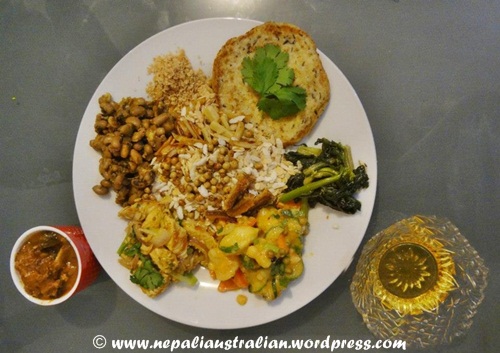
Typically it consists of  a variety of baji (beaten rice), haku musya (black soyabean), chhoela (smoked meat), puka-la (spicy roasted meat), aalu acha (boiled potato marinated with pickle), bhuti (boiled beans with spices), khen (boiled egg), panchkwa (bamboo shoot, potato, beans mixed curry), wo or bara (black lentil shallow fried pancakes, lava-palu (ginger and garlic), achar (pickle), wauncha (green vegetables) and aaila (Newari liquor). If you don’t have aaila, it can be replaced with any whiskey.

Samay baji is Newari food which is offered to the Gods on many occasions by Newars. This is the traditional dish and a regular item in many Newari festivals. Samay Baji is popular among Nepalese people because of its unique taste, unique cooking style and natural spices used in it.

Samay Baji

This year during Dashain, we tried to make Samay Baji and it had

Chiura (beaten rice)

Chiura, called Baji in Newari is beaten rice which is very popular in Nepal. Chiura is a common snack  in Nepal. The snack is made by pounding rice. The dish can be served with yogurt, curry, and or meat.

https://i0.wp.com/bossnepal.com/wp-content/uploads/chiura.jpg

Wo (black lentil shallow fried pancakes)

Wo is a Newari word which means mashed lentils cake and it is prepared from black lentils or green lentils (Mugh beans). Wo is called Bara in Nepali. There are different kinds of Wo depending on what is put in it and how it is cooked.

https://nepaliaustralian.com/wp-content/uploads/2011/11/2.jpg?w=500

Please click here for recipe

Aloo ko achar

Aloo ko achar is a very popular Nepali potato salad which is used in most bhoj in Nepal. There are many variations of this dish.
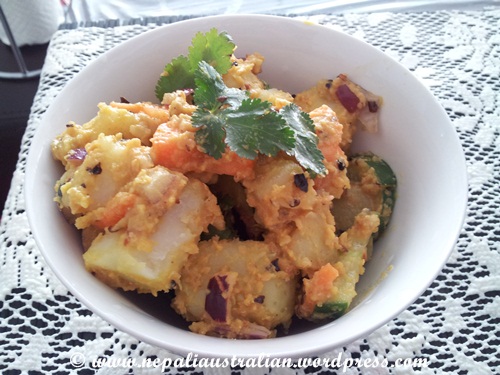
aloo ko achar (14)

Please click here for recipe

Chicken chhoela (smoked meat)

One of my favourite dishes and very popular in Nepal. an be made with goat , buffalo or chicken meat.

Chicken chhoela (10)

Please click here for recipe

Fried bhatmas (soyabeans)

Heat 1 tablespoon of oil in a pan and fry the soybean. When it is soft take it out of the pan and keep it aside and let it cool.

https://i0.wp.com/topnews.in/files/soya_1.jpg

Bodi (boiled black eyed beans with spices)

Soak bodi overnight. Press it in pressure cooker until cooked. Normally it will take 3-4 whistles. In a pan add oil, heat it a while then add the cooked bodi. Add garlic ginger paster, salt and chill and sauté for a while. Bodi is ready to be served.

https://i0.wp.com/static.flickr.com/62/210106145_c38f120456_b.jpg

Saag (green leaves)

https://i0.wp.com/3.bp.blogspot.com/_3xX21KaxjX4/Sr2Ck-5g4aI/AAAAAAAADLA/y8z7nsb-Cq4/s400/Sep-22-2009%2B003.jpg

You can use any type of green leave for this like English Spinach, Choy sum or Bok choy. You can either boil or fried it with some salt.

Khasi ko masu (Goat curry)

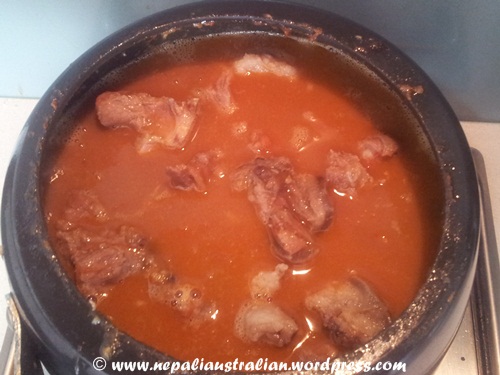
Khasi ko masu is one of the main dishes eaten during Dashain in Nepal. It can be made in different ways depending on personal preference.

goat curry (7)

Please click here for recipe

Fried fish

Just fry a few anchovies in oil.

https://i0.wp.com/1.bp.blogspot.com/_0CWdGn9Gu5c/TGag8GesbnI/AAAAAAAAEvA/vm2um9bllEE/s1600/netli%2Blast.jpg

Lava-palu (ginger and garlic)

Peel fresh garlic and cut into half.

https://i0.wp.com/farm4.static.flickr.com/3565/3602580339_ff9bfdde72.jpg

Peel ginger and cut into thin slices.

https://i0.wp.com/www.tigersandstrawberries.com/wp/wp-content/gingersliver.jpg

  • aaila (alcohol)

In Nepal, they make home-made rice wine aaila which is colourless. But that day we don’t have the typical newari wine so used rum.

http://theajnabee.files.wordpress.com/2010/10/gedc3073.jpg

Nepali style Goat curry (using a pressure cooker)

goat curry (1)

Ingredients

  • 2 red onions sliced
  • 2 tomatoes dices
  • 500gm goat meat
  • 10 curry leaves
  • 2 tablespoons of coriander powder
  • 2 tablespoons of garam masala
  • 3 tablespoons of ginger garlic paste
  • 3 tablespoons oil
  • 1 tablespoon of chilli powder
  • 2 teaspoons of turmeric powder
  • Salt to taste
  • Fresh coriander to garnish

 Steps

  • Take a pressure cooker and heat oil in it.
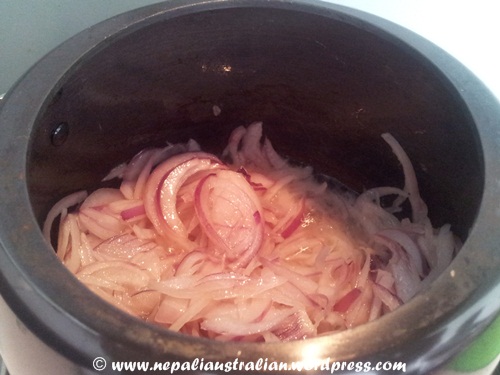
  • When the oil is hot add curry leaves and the finely sliced onions.

goat curry (2)

  • Add a pinch of salt so that the onion will get cooked quickly and becomes golden brown.

goat curry (3)

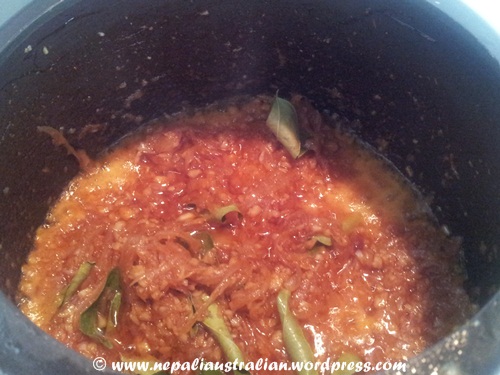
  • Add Ginger Garlic paste, garam masala, coriander powder, turmeric powder, salt, chili and let it cook for 2 mins.

goat curry (4)

  • Add finely diced tomatoes and let it cook completely, with the onion.

goat curry (5)

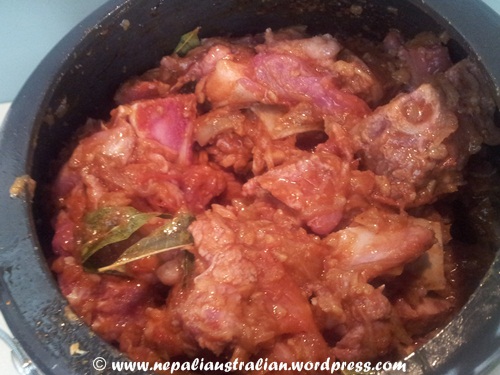
  •  Add the goat meat  to this mixture.
  • Let it cook for 10 min .
  • Add some water, close the cooker lid and keep the flame on medium
  • After 6 full (long) whistles, turn the heat off
  • Let the pressure in the cooker dissipate by itself; do not force the steam out by lifting the whistle etc.

goat curry (6)

  • When the pressure has dissipated, open the lid and check if the mutton is tender enough if not add some water if required and let the curry cook for about 3-5 min on low to medium heat
  • Garnish the goat curry with fresh coriander and it’s ready to server!

goat curry (7)

You may also like :

*Momo *Aloo ko achar *Chicken chili

Pushpa Basnet of Nepal is the 2012 CNN “Hero of the Year”

If you remember I wrote posts called Pushpa Basnet: Pride of Nepal and Please help Pushpa Basnet to win CNN Hero 2012 a few months ago regarding Pushpa Basnet.

https://i0.wp.com/sphotos-a.xx.fbcdn.net/hphotos-ash3/c0.0.300.300/p403x403/16022_485836934794337_243801918_n.jpg

She was shocked to learn that children were living in Nepali prisons with their parents and so she started the Early Childhood Development Center when she was only 21.  Since 2005, she has provided such support as housing, education, and medical care to more than 140 children of incarcerated parents.

https://i0.wp.com/texasnepal.com/news/wp-content/uploads/2012/03/Pushpa-Basnet.jpg

Yes, she has won CNN “Hero of the Year” for 2012 making us all proud. I am so happy that my vote counted and it is a great pride for Nepal to have the honour back in Nepal for a second time. Especial thanks to everyone who voted for her after reading my post.

https://i0.wp.com/3.bp.blogspot.com/-rB_Iq2uQN2U/ULwnr7dpvbI/AAAAAAAABEU/pd9MoancOlI/s1600/cnnhero%2Bpushpa%2Bbasnet.jpg

It is a so incredibly deserving recognition for someone who has scarified her life for the young children and their future. Please click here (Pushpa Basnet: Pride of Nepal and Please help Pushpa Basnet to win CNN Hero 2012 )to learn more about this incredible hero and an amazing human being. We are just very lucky to be born in an era where someone does selfless work like that.

Here is the incredible moment when she won the award.

Now Nepal has two great women as CNN Hero of the Year: Aunradha Koirala and Pushpa Basent.

Gautam Buddha

I had invited a few of my friends for dinner last weekend. One of them is from Thailand, another from Taiwan and another from China.  During our conversation, there was a mention of Buddha and Buddhism and I was so surprised to learn that all of them thought Gautam Buddha was born in India and they have no idea about Nepal’s connection to Buddha. The most surprising thing is that Thailand is a Buddhist country and my friend is Buddhist as well but they didn’t know Buddha’s correct history.

I know if you Google it, there are lots of places where you can read that Gautam Buddha was born in India but if you look at history, it has been proven that Buddha was born in Lumbini, Nepal but was enlightened near Bodh Gaya in India. So Nepal and India share the history behind Gautam Buddha.

So today I have decided to write this post. I don’t want to start a controversy here but just want to share what I know and learned regarding Gautam Buddha.

In general, ‘Buddha’ means ‘Awakened One’, someone who has awakened from the sleep of ignorance and sees things as they really are. A Buddha is a person who is completely free from all faults and mental obstructions. There are many people who have become Buddhas in the past, and many people will become Buddhas in the future….There is nothing that Buddha does not know. Because he has awakened from the sleep of ignorance and has removed all obstructions from his mind, he knows everything of the past, present, and future, directly and simultaneously. Moreover, Buddha has great compassion which is completely impartial, embracing all living beings without discrimination.

He benefits all living beings without exception by emanating various forms throughout the universe, and by bestowing his blessings on their minds. Through receiving Buddha’s blessings, all being, even the lowliest animals, sometimes develop peaceful and virtuous states of mind. Eventually, through meeting an emanation of Buddha in the form of a Spiritual Guide, everyone will have the opportunity to enter the path to liberation and enlightenment. The following excerpts about the life of Buddha are taken from Geshe Kelsang Gyatso’s book, Introduction to Buddhism. The story I know is same as below so sharing them with you.
Buddha’s Birth

The Buddha who is the founder of the Buddhist religion is called Buddha Shakyamuni “Shakya” is the name of the royal family into which he was born and “Muni” means “Able One.” Buddha Shakyamuni was born as a royal prince in 624 BC in a place called Lumbini, in what is now Nepal. His mother’s name was Queen Mayadevi and his father’s name was King Shuddhodana.

The Queens Dream

One night, Queen Mayadevi dreamed that a white elephant descended from heaven and entered her womb. The white elephant entering her womb indicated that on that very night she had conceived a child who was a pure and powerful being. The elephant’s descending from heaven indicated that her child came from Tushita heaven, the Pure Land of Buddha Maitreya. Later, when she gave birth to the child, instead of experiencing pain the queen experienced a special, pure vision in which she stood holding the branch of a tree with her right hand while the gods Brahma and Indra took the child painlessly from her side. They then proceeded to honor the infant by offering him ritual ablutions.

The Kings Delight

When the king saw the child he felt as if all his wishes had been fulfilled and he named the young prince “Siddhartha.” He invited a Brahmin seer to make predictions about the prince’s future. The seer examined the child with his clairvoyance and told the king, “There are signs that the boy could become either a chakravatin king, a ruler of the entire world, or a fully enlightened Buddha. However, since the time for chakravatin kings is now past it is certain that he will become a Buddha, and that his beneficial influence will pervade the thousand million worlds like the rays of the sun.”

The Young Prince

As the young prince grew up he mastered all the traditional arts and sciences without needing any instruction. He knew sixty-four different languages, each with their own alphabet, and he was also very skilled at mathematics. He once told his father that he could count all the atoms in the world in the time it takes to draw a single breath. Although he did not need to study, he did so to please his father and to benefit others. At his father’s request he joined a school where, in addition to various academic subjects, he became skilled at sports such as martial arts and archery. The prince would take every opportunity to convey spiritual meanings and to encourage others to follow spiritual paths. At one time, when he was taking part in an archery contest, he declared, “With the bow of meditative concentration I will fire the arrow of wisdom and kill the tiger of ignorance in living beings.” He then released the arrow and it flew straight through five iron tigers and seven trees before disappearing into the earth! By witnessing demonstrations such as this, thousands of people developed faith in the prince.

Witnessing Suffering

Sometimes Prince Siddhartha would go into the capital city of his father’s kingdom to see how the people lived. During these visits he came into contact with many old people and sick people, and on one occasion he saw a corpse. These encounters left a deep impression on his mind and led him to realize that all living beings without exception have to experience the sufferings of birth, sickness, ageing and death. Because he understood the laws of reincarnation he also realized that they experience these sufferings not just once, but again and again, in life after life without cessation. Seeing how all living beings are trapped in this vicious circle of suffering he felt deep compassion for them, and he developed a sincere wish to free all of them from their suffering. Realizing that only a fully enlightened Buddha has the wisdom and the power to help all living beings in this way, he resolved to leave the palace and retire to the solitude of the forest where he would engage in profound meditation until he attained enlightenment.

Prince Siddhartha’s Marriage

When the people of the Shakya kingdom realized that the prince intended to leave the palace they requested the king to arrange a marriage for him in the hope that this would cause him to change his mind. The king agreed and soon found him a suitable bride, the daughter of a respected Shakya family, called Yasodhara. Prince Siddhartha, however, had no attachment to worldly pleasures because he realized that objects of attachment are like poisonous flowers, which initially appear to be attractive but eventually give rise to great pain. His resolve to leave the palace and to attain enlightenment remained unchanged, but to fulfill his father’s wishes and to bring temporary benefit to the Shakya people, he agreed to marry Yasodhara. However, even though he remained in the palace as a royal prince, he devoted all his time and energy to serving the Shakya people in whatever way he could.

Prince Siddhartha’s Request

When he was twenty-nine years old, the prince had a vision in which all the Buddhas of the ten directions appeared to him and spoke in unison saying, Previously you resolved to become a Conqueror Buddha so that you could help all living beings trapped in the cycle of suffering. Now is the time for you to accomplish this.” The prince went immediately to his parents and told them of his intention: “I wish to retire to a peaceful place in the forest where I can engage in deep meditation and quickly attain full enlightenment.

Once I have attained enlightenment I shall be able to repay the kindness of all living beings, and especially the great kindness that you have shown me. Therefore I request your permission to leave the palace.” When his parents heard this they were shocked, and the king refused to grant his permission. Prince Siddhartha said to his father “Father, if you can give me permanent freedom from the sufferings of birth, sickness, ageing and death I shall stay in the palace; but if you cannot I must leave and make my human life meaningful.”

Prince Siddhartha’s Escape

The king tried all means to prevent his son from leaving the palace. In the hope that the prince might change his mind, he surrounded him with a retinue of beautiful women, dancers, singer, and musicians, who day and night used their charms to please him; and in case the prince might attempt a secret escape he posted guards around the palace walls. However, the prince’s determination to leave the palace and enter a life of meditation could not be shaken. One night he used his miracle powers to send the guards and attendants into a deep sleep while he made his escape from the palace with the help of a trusted aide. After they had travelled about six miles, the prince dismounted from his horse and bade farewell to his aide. He then cut off his hair and threw it into the sky, where it was caught by the gods of the Land of the Thirty-three Heavens. One of the gods then offered the prince the saffron robes of a religious mendicant. The prince accepted these and gave his royal garments to the god in exchange. In this way he ordained himself as a monk.

A Suitable Place for Meditation

Siddhartha then made his way to a place near Bodh Gaya in India, where he found a suitable site for meditation. There he remained, emphasizing a meditation called “space-like concentration on the Dharmakaya” in which he focused single-pointedly on the ultimate nature of all phenomena. After training in this meditation for six years he realized that he was very close to attaining full enlightenment, and so he walked to Bodh Gaya where, on the full moon day of the fourth month of the lunar calendar, he seated himself beneath the Bodhi Tree in the meditation posture and vowed not to rise from meditation until he had attained perfect enlightenment. With this determination he entered the space-like concentration on the Dharmakaya.

Conquering all Distractions

As dusk fell, Devaputra Mara, the chief of all the demons, or maras, in this world, tried to disturb Siddhartha’s concentration by conjuring up many fearful apparitions. He manifested hosts of terrifying demons, some throwing spears, and some firing arrows, some trying to burn him with fire, and some hurling boulders and even mountains at him. Through the force of his concentration, the weapons, rocks, and mountains appeared to him as a rain of fragrant flowers, and the raging fires became like offerings of rainbow lights.

Seeing that Siddhartha could not be frightened into abandoning his meditation, Devaputra Mara tried instead to distract him by manifesting countless beautiful women, but Siddhartha responded by developing even deeper concentration. In this way he triumphed over all the demons of this world, which is why he subsequently became known as a “Conqueror Buddha.”

Attaining Enlightenment

Siddhartha then continued with his meditation until dawn, when he attained the varja-like concentration. With this concentration, which is the very last mind of a limited being, he removed the final veils of ignorance from his mind and in the next moment became a Buddha, a fully enlightened being.

Turing the Wheel of Dharma

Forty-nine days after Buddha attained enlightenment he was requested to teach. As a result of this request, Buddha rose from meditation and taught the first Wheel of Dharma. These teachings which include the Sutra of the Four Noble Truths and other discourses, are the principal source of the Hinayana, or Lesser Vehicle, of Buddhism. Later, Buddha taught the second and third Wheels of Dharma, which include the Perfection of Wisdom Sutras and the Sutra Discriminating the Intention respectively. These teachings are the source of the Mahayana, or Great Vehicle, of Buddhism. In the Hinayana teachings Buddha explains how to attain liberation from suffering for oneself alone, and in the Mahayana teaching he explains how to attain full enlightenment, or Buddhahood, for the sake of others. Both traditions flourished in Asia, at first in India and then gradually in other surrounding countries, including Tibet. Now they are also beginning to flourish in the West.

Practicing Buddha’s Teachings

“Dharma” means “protection”. By practicing Buddha’s teachings we protect ourself from suffering and problems. All the problems we experience during daily life originate from ignorance, and the method for eliminating ignorance is to practice Dharma.

Practicing Dharma is the supreme method for improving the quality of our human life. The quality of life depends not upon external development or material progress, but upon the inner development of peace and happiness. For example, in the past many Buddhists lived in poor and underdeveloped countries, but they were able to find pure, lasting happiness by practicing what Buddha had taught.

If we integrate Buddha’s teachings into our daily life we will be able to solve all our inner problems and attain a truly peaceful mind. Without inner peace, outer peace is impossible. If we first establish peace within our minds by training in spiritual paths, outer peace will come naturally; but if we do not, world peace will never be achieved, no matter how many people campaign for it.

Lumbini

An important place of pilgrimage for Buddhists, Lumbini was declared a World Heritage site in 1997 by the United Nations Educational, Scientific and Cultural Organization. Located 200 kilometers southwest of Nepal’s capital Kathmandu and 20 km north of the Indian border, Lumbini has an array of millennia-old monuments.

There is the Mahadevi temple complex, where a stone marks the site where Siddhartha Gautama was born. Sculptures of Queen Mayadevi dating back to the 4th century AD and an infant Siddhartha are located here. A pillar erected by the Mauryan emperor Asoka commemorates his visit to Buddha’s birthplace and bears the first epigraphic evidence relating to the birthplace of Buddha.

Bhogate Sadekoo

One of the things widely eaten in Nepal after the festival of Tihar is, Bhogate Sandheko. Bhogate is called Pomelo (Chinese grapefruit) in English and is used in Nepal during Mha Puja and Bhai Tika. Bhogate Sandheko roughly translates to marinated pomelo in English.

You may also like :

*Momo *Chatamari *Chicken chili

Pomelo is a crisp citrus fruit native to South and Southeast Asia. It is usually pale green to yellow when ripe, with sweet white (or, more rarely, pink or red) flesh and very thick albedo (rind pith).

Pomelo tastes a bit like grapefruit but is sweeter, less tart, and is not bitter. In Australia, we can’t find pomelo so the closest thing to Bhogate is grapefruit which is what I used in Bhai Tika during Tihar.

So like my mum used to, I tried to make Bhogate Sadekoo and am sharing my recipe here.

Ingredients:

  • 1 grapefruit/pomelo
  • 2  oranges  (I used oranges but you can use any fruit)
  • 4 tablespoons of  plain yogurt
  • 2 teaspoon of red chili powder (or to taste)
  • 2 tablespoon of sesame seeds, roasted and ground
  • Salt to taste
  • Sugar to taste (optional)
  • 2 teaspoons of mustard oil
  • 1 teaspoon fenugreek seeds (methi)
  • ½ teaspoon turmeric

Process

  • Peal grapefruit/pomelo and oranges and put it in a bowl .

  • Roast sesame seeds in a pan stirring constantly making sure it turns golden brown, not black.
  • Cool it and grind it.

  • Add yogurt, salt, sugar, sesame powder, red chili powder in the bowl with the pomelo and oranges and mix well

  • Heat a pan with mustard oil in it
  • When hot put fenugreek seeds in it
  • When the fenugreek seeds turn golden brown, take it off the heat and pour oil with fenugreek into the Bhogate mixture in the bowl

  • Mix it well

  • Bhogate Sandheko is ready to serve, yum yum yum 🙂