Category Archives: Nepal

Bahra

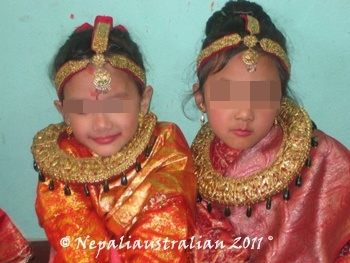
As I mentioned in my previous post Ihi’, every Newar girl have to perform the ritual called ‘Ihi’ and after ‘Ihi’, they have to perform the ritual called ‘Bhara’.

Bahra’ is also known as ‘’Bahra tyagu” in Newari and Surya Darshan or Gufa rakhne in Nepali. In this ceremony, the girl is married to the sun.

In some culture, this ceremony is done when the girl has her first menstruation and in other cultures, it occurs after they get an auspicious date from a priest .

It is believed that the girl is protected by the sun from bad people and the evils after this ceremony.

For this ceremony, a girl will stay in a room of her house for 12 days without seeing sunlight and not meeting any male person. ( I still don’t know the reason for this so please share if you know).

In the room at one corner, a cloth is put as Bahra Khayak (ghost) and worshipped by the girl as she is believed to be in possessed by evil. Before she eats anything, one portion needs to be separated for Khayak. If the ritual is not followed, it is believed, the Khayak will scare the girl at night. 

My Bahra ceremony

The hardest part of the ritual is not to eat salt during the first 6 days. I was only 13 years old when I had my Bahra and I remember crying for salt everyday as food doesn’t taste good without salt. As this culture is different among different families, I am writing about how members of my own family go through this tradition.

After the sixth day, close female relatives like maternal uncles (mama), dad’s sisters (fufu) and other relative will come and meet the girl with food like popcorn and Rotis and fruits. Also from the sixth day, there will be powder called ‘Koaa’ which is used by all the women to make them look beautiful. You have to follow a special direction to use this and it is meant to clean the skin. It is used especially by the Bahra girl to look good when she come out of hiding on the 12th day.

Step to use Koaa.

  • Wash your hands, legs and face with water first.
  • Mix the ‘Koaa’ with water and make a paste. Then put the paste all over your face, legs and hands
  • Leave it for a few minutes to dry.
  • Now rub oil on your hands and remove the paste from your face, legs and hands.

    Alha during Bahra
In these 12 days the girl will be entertained by her female friends and relatives. While I was in my room we had ludo, snake and ladder and dolls to play with. As my family was ok for me to hear male voice we had radio so we used to play it loud and dance.

Some days went really quick as I had many visitors around and then there were days which were so long, I couldn’t wait to go out.

On 12th day there will be a big celebration of the ending of this ceremony.
Surya darshan during Bahra

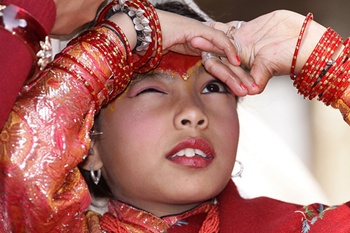
In the morning, the girl purifies herself  by taking a bath. Then she is dressed in bridal sari and make up. She will then be covered my shawl and take to the open space where Puja is performed. There will be Ganesh Puja first and then Surya Puja followed by Surya Darshan. It will be the first time the girl will see the sun in 12 days. Also Sindoor is put on the girl’s forehead as a symbol of marriage to the sun and a yellow string is put around her head.

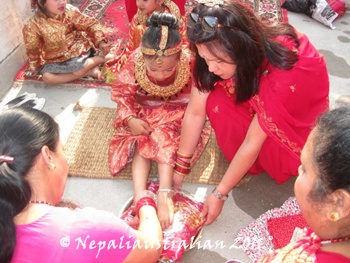
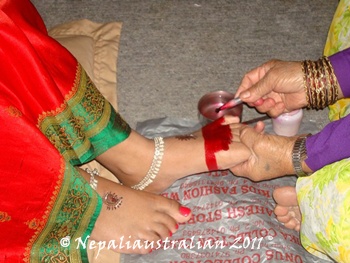
Like in Ihi, there will be a special person who cuts toe nails for the girl and then paints the feet with red colour called ‘Alah’. Also, ‘Thaa bu’, a plate which has eggs, yogurt, wine, fruits, Roti, meat, fish and much more for the girlsto eat is served like in the real wedding.

Then she will be given Sagun and gifts by family and relatives. Also after this Puja, the girl will go with her relatives to a nearby temple and do more Puja.

In the evening of that day there will be a big bhoj (party) and lots of relatives and friends are invited.

After this ceremony the girl becomes an adolescent.

Ihi

According to Newari tradition, girls are married three times in their lives.

First one is called ‘Ihi’ then ‘Bara Tayegu’ and then the real human marriage.

I am writing about the first marriage in Newar girl’s life which is called ‘Ihi’. “Ihi’ is also known as Bel Bibaha in Nepali. It is performed before a girl turns 13 years old. It is a compulsory ceremony every girl has to go through in most Newar community.

I too had the ceremony held for me but I can’t remember a lot about that day. I was quite small, I think 7 or so years old when the ‘Ihi’ was held for me.

In ‘Ihi’ ceremony, the girl is married to Lord Vishnu with the bel fruit (wood apple) as a witness. This ceremony is performed to save the girl from evil and malicious spirits but the most important reason is to protect the girl from unpleasant humiliation of widowhood.  As I mention in my post Widows in Nepal, it is really hard for the women in Nepal when they become widows. They had to take part in ‘Sati’ process in the old days, so in order to save their daughters from ‘becoming Sati’, Newars started a tradition in which they married their daughters to Lord Vishnu first. So even if her human husband dies in the course of her life, she doesn’t need to take part in ‘Sati’ ritual since her first husband, Lord Vishnu is still alive.

Some also believed this tradition allowed women to be more independent of their husbands. They can divorce or become widows without losing reputation.

Ihi is performed in mass over two days. It is normally organised by priests in their own house or backyard or someone can choose to host it in their house.

The first day is called Dusala Kriya. On this day, young girls have to bathe with pure water and are dressed like a bride in ankle length skirt, blouse and shawl. These days, you will see them as mini versions of traditional Nepali brides. Then all the girls will gather in the priest’s house. They sit on the floor in a long line with their mothers. Then the Puja begins where these girls go through sequences of ritual actions of purification. They have to worship images of Suvarna Kumara, the golden Bachelor which is an aspect of Lord Vishnu. It normally takes 5-6 hours for this ceremony to be over.

The second day is the most important day of the ritual  ‘Kanyadan’ (giving away of the daughter by the father) is performed on this day. For this day as well, the young girls are dressed as brides and taken for the Puja. On this day, they wear some special ornaments as well.

There will be a special person who cut toe nails for all the girls  and then paint the feet with red colour called ‘Alah’. Also at the end of the day, ‘Thaa bu’ , a plate which had eggs, yogurt, wine, fruits, Roti, meat, fish and much more for the girls to eat is served like in the real wedding.

There will be more Puja performed and the day will end by the father doing a ‘Kanyadan’ and giving away his daughter to Lord Vishnu in marriage with the Bel fruit as a witness.

‘Ihi’ is one of the many tradition the Newar community in Nepal follow and is unique to them.

Dhau baji

As I have previously mentioned in  I see babies everywhere  my friend SK is pregnant and she is expecting a baby girl on December 13. 

Last weekend we went to visit her for ceremony called Dhau-baji in Newari or Dahi-Chiura in Nepali. 

We were planning a baby shower but as her parents are here it became a Dhau-baji ceremony. 

SK and her Dhau baji

Dhau-baji feeding is a Newari culture, similar to baby shower in the western world. A girl’s family comes to feed Dhau-baji (yogurt and flattened/beaten rice) on the ninth month of pregnancy.  They bring Sagun and lots of food along with gifts for the mother as well as the unborn baby. 

As her parents are staying with her now, they just went and bought lots of food. They prepared Puja, made Sagun and the ceremony began. 

First both my friend SK and her husband got their tika, made out of vermillion, rice and yogurt. Then they were given Sagun consisting of boiled egg, bara, a piece of chicken and fish with yogurt. It was followed by a plate of fruits and flattened rice with yogurt. 

Then they had some gifts for both the new parents to be. 

I along with my friends, SS and SD were bit unaware of the traditional ceremony so we ended up buying cupcakes, flowers and gifts for the baby. I am glad SK loved it.

I think it is so important to have your parents and in-laws around when you are pregnant and having a baby. I would love to follow our Newari tradition but sometime we are not aware of what needs to be done as per the tradition. If it was only us, SK would have got a baby shower but as her mum was here, it turned into Dhau-baji

two yummy mummies to be

Ohoo, can’t wait for December, 2 new babies on the way. 

SD is my another friend who is also pregnant but we still haven’t planned her Dhau-baji / baby shower as she is still waiting for her mum to get her visa to come to Australia. I really wish she gets that good news soon as SD is stressing about it a lot and it is not good for her baby. It will also be better for her mum to be here when we have the ceremony for her. 

Finger crossed!!!

Prabal Gurung : A Fashion designer from Nepal

It is always so good to see anyone from Nepal doing well in an international level and I am so glad to see Prabal Gurung in the international fashion arena.

I saw his designs on Michelle Obama, Demi Moore, Zoe Saldana and Oprah Winfrey. I just love him and his creations.

Here is the excerpt from his website introducing him.

 “Gurung was born in Singapore and raised in Kathmandu,Nepal. It was in New Delhi,India that his design career truly began. While studying at New Delhi’s National Institute of Fashion Technology, Gurung freelanced at several production and fashion houses and apprenticed with Manish Arora. His travels took him to Melbourne and London, where he assisted stylists for various fashion shows and editorials at international publications. In 1999, Gurung moved to New York City. He began his career in New York interning for Donna Karan while attending Parsons School of Design. In his first year, he was awarded the “Best Designer” title at the annual Parsons /FITdesign competition.

After Parsons, Gurung spent two years with Cynthia Rowley’s design and production team, which allowed him to gain even more invaluable experience within the fashion industry. Soon after, he was appointed design director at the iconic Bill Blass. After five successful years, Gurung left his post at Blass to launch his own collection, PRABAL GURUNG.”

Look at his collection from Spring 2012 collect here . They are so amazing and beautiful. No wonder so many celebrities loves his collection.


Sarah Jessica Parker  was in Australia recently and she wore Prabal Gurung. It was just beautiful.

 He is also the goodwill ambassador for Maiti Nepal .  This is what he told ekantipur about his association, “A society free from human trafficking is possible and we must realise that it is our responsibility to make this world a better place for all mankind. By simply stating our desire, we sow the seeds of great change,”

 Best wishes for all the good work.

 Sources

You may also like :

*Varsha Thapa: First international fashion model from Nepal *The magic of Prabal Gurung continues *Prabal Gurung: Designer in the Spotlight

Nepali Culture, Customs and Etiquette

Over the years I have noticed many cultures, customs and etiquettes of Nepal which are so different from what we find in western countries. I am sharing a few of them here. 

  • In Nepal, everyone is your Brother, Sister, Uncle or Aunt even if you are not related. 
  • It is normal to slurp tea or any drink when you are out and about. 
  • Superstition goes hand in hand with culture. For example if a cat crosses the road, you wait for someone else to cross that path before you cross it. 
  • You should not step over an idol of a god or goddess or anything that is used to worship them. This is seen as a disrespect to god to step over them. A lot of time if someone is coming up the steps with Puja items you are not allowed to go up of down the steps above them as this constitutes stepping over the Puja items. 
  • Sharing is caring in Nepal so if you have a Kit Kat bar, you still ask who ever is around you and break that bar into pieces to share. 
  • Fat is good in Nepal so if someone in Nepal said you look fat, don’t get offended. He/she is giving you a compliment on how healthy you look. 
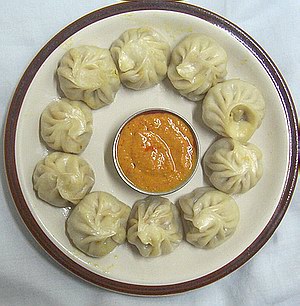
  • Momo is the best food in the world (according to every Nepali) 
  • PDA (Public displays of affection) is a big NO NO. 
  • As respect to the God and Goddess, one should always take off your shoes before entering a temple. 
  • In most Nepali homes you should not wear shoes in the rooms, they have to be taken off before entering any room. 
  • Ask for permission before entering a Hindu temple. In some temples, only Hindu’s are allowed. 
  • Taking photographs inside most temples is not allowed. 
  • You always walk around a temple in clockwise direction. 
  • You will notice lots of people touch their forehead with their fingers as they pass by the temples. It is acknowledgement of God and showing respect. 
  • Never enter anyone’s kitchen until they ask you to. 
  • Staring is ok (I know it is silly). 
  • It is normal to find people of the same sex walking together hand in hand (girl and girl or even boy and boy) but boy and girl can’t walk hand in hand without being stared at. 
  • People call each other Sir or Madam, like Mohan Sir or Rita Madam in the workplace. 
  • Bargaining is the first rule of shopping in Nepal. [I have paid twice the price of an item even when I bargain 😦 ] 
  • You will notice Nepali people shake their head a lot. If the head shakes (sways) from side to side it is YES an if it shakes from side to side (face turns from side to side) it’s a NO. 
  • When there is a visitor, they serve tea and egg. Noddles like Wai Wai and Maggie are served as lunch. 
  • If you are meeting someone and they didn’t come in time, don’t be surprise. It is called Nepali time which is to come a bit late to your appointment. 
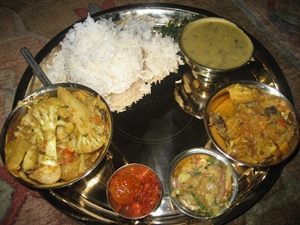
  • Dal Bhaat Tarkai can be breakfast , lunch and dinner. 
  • Nepali people don’t eat beef and until recently it was illegal to even sell beef. 
  • When woman has her period, normally they are considered impure and they are not allowed in the temple and kitchen for four days. 
  • There are no fines for littering in Nepal so you see people throwing things on the street even if the bins are just a few feet away. 
  • It is considered rude to touch any one’s head. 
  • In Nepal, you don’t eat and serve yourself. It is considered Jutho (impure) to touch the cooking pots while you are eating. 
  • Left hand is considered impure/Jutho so you never pass things around with your left hand. 
  • If someone dies in the family, the family will not celebrate any festivals or birthdays for a year and there will be no wedding or any other happy celebrations for that year. 
  • If someone touches their throat with their fingers then they blow on the fingers. Not blowing on it is believed to cause swollen glands in the throat. 
  • Footwear should not be left upside down as it will cause bad luck. 

  • You can see some vehicles in Nepal with a slipper hanging in the front (or rear). This is said to ward of evil (bad eye) so that accidents will not befall the vehicle. 
  • You should not say the word for Witch in Nepali, it is believed to bring you to the attention of a witch and she will harm you. 
  • If you find a mysterious bruise on the body, it is thought to be because a witch drank your blood. 
  • You should not pee on a Pipal tree as they are usually haunted by a witch and she will harm you for peeing on her home. 
  • You should not touch most stuff (that are not meant to be touched with the feet) with your feet, since everything is thought to have an essence of God and touching them with the feet is disrespecting God. Especially things for learning, as Saraswati is the goddess of learing and pillows as you normally put your head on it, etc. 

There are many other things but I will leave that for another post.