Category Archives: Nepal

Learn Nepal Bhasa / Newari – Chapter 14


English Nepal Basa
Boiled Ma-naa-tah-gu
Fried Pu- kaa-tah-gu
Jellied Khway-kaa-tah-gu
Roasted Chhu-yaa-tah-gu
Seasoned Waa-laa-tah-gu
Steamed Haa-yaa-tah-gu
Is there a restaurant around here? Tha-na ha-nann restaurant du la?
I will have a plate of momo. Ma-ma cha chha-guu plate ha-yaa di-saa.
Please bring it quickly. Yaa-ka naa ha-yaa di-saa.
Is it spicy? Paa-lu laa?
This is not what I ordered. Jinn dha-yaa-gu thaw ma-khu.
Please being the bill. Bill bi-yaa-di-saa.
Dinner is served. Be-li yaa-ye ji-la.
Only a small portion, please. Bha-ti-chaa ja-ka ta-yaa di-saa.
No more, thank you. Ji-tah gaa-ta.
I would like some water. Lah bi-yaa di-saa.
I would like more rice. Jaa bha-chaa ta-yaa di-saa.
Please give me a spoon. Cham-chaa chha-guu bi-yaa di-saa.
What is the name of this food? Thwa na-saa-yaa naa chhi khah?
Does it contain meat? Thu-ki-I laa du laa?
May I step inside? Du-ne wa-ne jii laa?
Do I have to take off my shoes? Laa- kaa twah-te maah laa?
Yes/no Maah/mwah
What god is kept in there? A-na chhu dyah ta-yaa tah-gu du?
Can I take a picture? Tas-bir kaa-ye jii laa?
What’s that temple? Wa chuu de-gah?
We come to see the procession. Ji-pii jaa-traa swah-was-yaa-gu.
Will the procession pass this way? Jaa-traa tha-naa hai la?

Please click here for previous chapters.

Pashupatinath and Guheswari temple

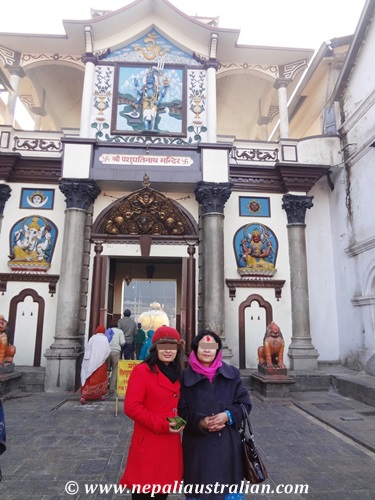
Pashupatinath Temple is one of the most significant Hindu temples of Lord Shiva in the world, located on the banks of the Baghmati River in the eastern part of Kathmandu, the capital of Nepal. Every time I am in Nepal I try to go and visit the temple and last time, I went there with AS and my MIL. It was a cold winter morning and I really love that time of the year in Kathmadu.
Pashupathi (1)

The temple serves as the seat of the national deity, Lord Pashupatinath and is listed in UNESCO World Heritage Sites list.

According to Nepal Mahatmaya and Himvatkhanda one day Lord Shiva grew tired of his palace atop Mt. Kailash and so went in search of a place where he could escape to. He discovered Kathmandu Valley and, without telling anyone, he ran away from his palace and came to live in the Valley. He gained great fame there as Pashupati, Lord of the Animals, before the other gods discovered his hiding place and came to fetch him. He disguised himself as a majestic deer and would not help the other gods when they asked for his help. When Shiva did not yield to their pleas, they planned to use force. Vishnu grabbed him by his horns and they shattered into pieces. Vishnu established a temple and used the broken horns to form a linga on the bank of the Bagmati River.

As time went by, the temple was buried and forgotten. One day a cow was seen to secretly sprinkle her milk over a mound. Apparently, when the cow herders dug at the spot, they found the lost linga and again built a temple at the same spot in reverence of Lord Shiva.

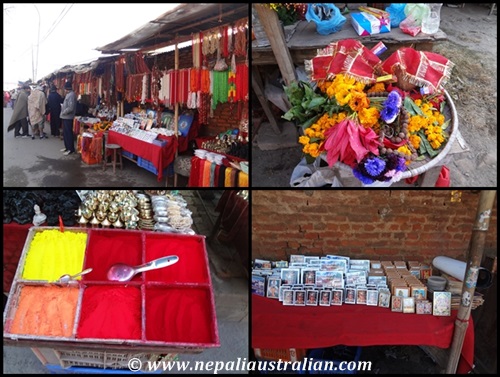
 After we parked the car we have to walk for a while to reach the gate of the main temple. There at lots of vendors selling flowers and necessary items for puja as well as small souvenirs and idols of Hindu gods on either side of the road.
Pashupathi (2)

As usual all of the vendors were eager to grab a customer and shouting at passers-by. My MIL law decided to buy a few stuffs from one vendor as we walked towards the main door. Before you reach the main door, you have to take off your shoe and socks off and wash your feet before going into the temple (imagine how cold my feet were getting in a winter morning on stone floors).

From there we approached the main door. I know that non Hindus are not permitted inside this door and you are not allowed to take leather items and camera inside.

Pashupathi (4) Pashupathi (3)

As it was a weekday, the temple was not too busy. But there were a large group of Indian devotees in the queue. Pashupatinath is very famous among Indian Hindu and every year busloads of them come to Kathmandu to pray and worship.

Also there were many Sadhus seen in Pasupatinath. There are holy people, who live in isolation, to achieve liberation. But behind the painted faces, one never knows how pious they are.

After we walked around the main temple of Pashupati, we were going to many Lingams of Pashupati and, I happen to look down on the Baghmati River.  There were funerals taking place on either side of the river. I was glad I didn’t see the dead body but they were loading logs of wood on the podiums for cremations and, the air was thick with the smell of smoke. In Hindu religion, when a person dies, they are cremated. First there are the rituals of washing the body (purifying it) and lighting lamps all around it to protect the body. Then the body is loaded on the logs and the eldest son of the family lights the fire on the log. If one has no sons, then it will be done by father, brother or any other male member of the family.

In olden days if a woman’s husband died, she was required/ pressurised to burn with him. The process is called Sati. The act of Sati, in which a Hindu widow immolates herself on her husband’s funeral pyre as a final and consummate act of loyalty and devotion, is patterned after the deed committed by a goddess to uphold the honour of her husband. I am just glad it is not practiced these days.

I still hate the other ritual Nepali women practice when their husband dies. Please read this post for more details.

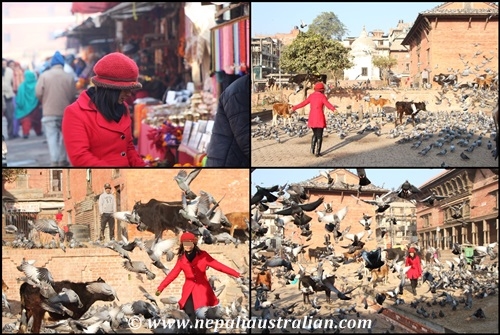
After that we came out from the main door and went to get our shoes. There were lots of pigeon and cow just roaming around there so I decided to take a few photos with them.
pashupathi

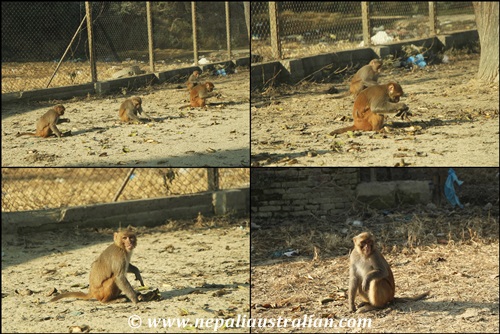
As we left the temple, we saw a whole hoard of monkeys! I find them very frightening, especially when they show their teeth and hiss but AS was happy taking their photos.
Pashupathi (8)

From Pashupatinath we went to the nearby Guheswari temple.

It is one of the revered holy temples in Kathmandu, Nepal. This temple is dedicated to Adi Shakti. This refers to the popular legend where Shiva distressed was carrying the corpse of Devi Sati and Vishu annihilated it with his Sudarshan Chakra. Shiva later declared the 51 such places where Devi Sati’s body parts fell were to be worshipped as the Shakti Peethas and meditated at all these places as various forms of Bhairavas. The place where Devi Sati’s knees fell is Guheswari in Kathmandu. In Nepal the form of Shakti is Mahashira and the form of Bhairava is Kapali. King Pratap Malla built this temple in the 17th century. The temple name originates from guhya (cave) and ishwari (goddess). Non-Hindus are not allowed to enter this temple as well.

Pashupathi (5)

We went inside the temple and there were not many people there. We just prayed and went around the temple and were out in a few minutes.
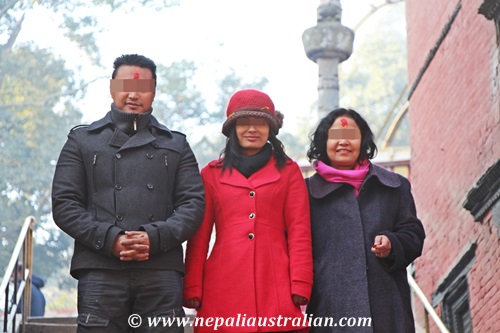
Pashupathi (6)

The temple of Guheswari houses no image of any Goddess but has been regarded as a place of worship since times immemorial. Many believe this to be the temple to go to in order to pray for marital fidelity and a lot of Hindus will make the trip here to ensure that their marriage does not suffer.

For us, it was a quick stopover before we headed home to our warm cup of tea and warm jeri swari 🙂

Till next time, take care

M from nepaliaustralia

XOXO

You may also like:

*Manakamana Temple *Cheers to new year 2070 *Zoo visit in Nepal

.

Recycling and reusing in Nepal

This article was published in +977 (a Nepalese Lifestyle Magazine in Australia) in April 2013 issue.

recycling post blog

My recent visit to Nepal has given me inside to many things and one of them is recycling and using anything and everything possible.

Recycling is very important, but even better is reusing. I was really impressed on reusing skill on people from Nepal. From old metal cans, plastic bags, old newspapers, packing containers and old clothes, Nepali housewives especially found ways to give second life for simple items around their home by reusing them.

I really think people living in west are spoiled and they really need to learn how to reuse and recycle than buying things that are use and throw. I have to admit, even though I am conscious about recycling and reusing, I have a long way to go to be anywhere near these housewives. I am going to remember from now on that not everything is destined for the rubbish bin. I need to think before I throw.

No matter how rich or how poor people are, most Nepali people reuse lots of thing and this is what I observe.

  • Plastic grocery bags used as small trash can bags.
  • Ziplock bags washed and reused.
  • Worn out clothes used as rags to clean floors and windows.
  • Margarine and butter tubs used as takeaway containers.
  • Everyone unwrap their gifts very careful so they can reuse the wrapping paper.
  • Shoe boxes used as storage containers for small items.
  • Old toothbrush used to clean hard to reach areas like around the sink, your drains, faucets and grout.
  • Newspaper used for cleaning windows and mirrors. Also it is used to clean up after pets.
  • Old glass bottles from tomato sauce or honey used as storage container for herbs and spices in the kitchen.It can be also be used as a stationary organiser.

  • Small jars from jams used as candle holders.
  • Old saucers used as soap dishes.
  • Mugs are used as utensil holders.

  •  Leftovers are put in freeze and used in fried rice the next day.
  • Any kind of boxes used as storage containers or organisers.
  •  Plastic milk jugs, juice containers, big coke bottles used to store water.
  •  Small plastic water or soda bottles used to take water with you while out and about.

If you are interested in any of the ideas, please Google and you will find heaps of ideas on how to turn your trash into treasure and you will be surprised how good they look. Also it will help you save some money and you are doing your bit to save the environment.

Do you recycle?

Till next post, take care.

M from nepaliaustralia

XOXO

You may also like :

*Paragliding in Paradise 


*Forever Blackout 
*Bolne ko pitho bikchhare, nabolne ko ta chamal pani bikdaina
 

Seviya kheer (vermicelli kheer)

Yesterday AS felt like having Seviya kheer out of the blue so I decided to make one. Seviya is fried vermicelli noodles. I bought a packet of fried Seviya from an Asian grocery store. This was the first time I tried it and I have to admit, it was very easy.

Seviya kheer  (2)

Seviya kheer  (3)

Ingredients

  • 200gm vermicelli
  • 800 ml milk
  • 3 tablespoons sugar (add more or less according to your taste)
  • 2 tablespoons ghee/clarified butter
  • 7-8 roasted or fried unsalted almonds, chopped

Instructions

  • Heat ghee in a pan and when it is melted add vermicelli and fry till they become golden brown.

Seviya kheer  (4)

  • Pour the milk and let it come to a boil.

Seviya kheer  (5)

  • Add sugar and mix well.
  • Lower the flame and let the milk simmer for 5-7 minutes till the vermicelli gets cooked.

Seviya kheer  (1)

  • Add chopped almonds.
  • Serve the kheer hot, warm or cold.

Seviya kheer

  • I prefer mine cold :). Enjoy!

Namo Buddha : Nepal

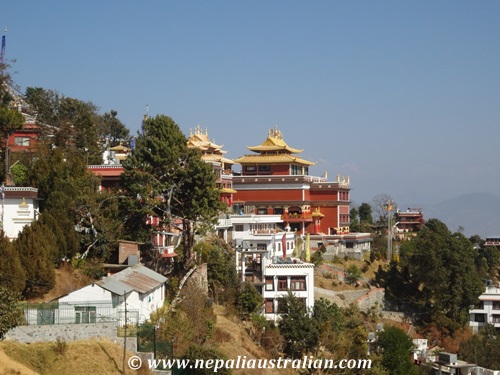
Namo Buddha is about 40km away from the heart of Kathmandu City. It is in Kavre District towards the southeast of the valley. Driving from Kathmandu, it took us around 2 hours to get there. We left the paved road and drove on dirt road after an hour. After about 45 minutes we caught a glimpse of the temple through the clouds.

namo buddha  (1)

Namo Buddha is a beautiful place far from the hustle and bustle of Kathmandu, with no pollution, and the air is so fresh and cool. Situated at an elevation of 1750 m above sea level, Namo Buddha is a great tourist destination around Kathmandu valley. From the top of the hill you can see the snow-covered Himalayan ranges which look so pure and amazing.

namo buddha  (3)

From the Buddhist point of view, Namo Buddha is one of the most important religious sites in Nepal. There are three major Buddhist pilgrimage sites: Boudha Stupa, Swayambhunath Stupa and Namo Buddha.

I went there with my parents and an aunty.Once we parked the car, we had to go through a big gate to reach the stupa. The stupa was not as big as Boudha Stupa, Swayambhunath Stupa but has high significance.

namo buddha  (4)

According to history around 6000 years ago prince Great Being (Ngingdui Tshenpo Mahasatwo), found a tigress lying near a rock at the top of the hill, overlooking the jungle. Very quickly, he realized that she was going to die. Her five babies were still little and their survival depended on their mother. Ngingdui Tshenpo,  was a young man who had his own kingdom but he decide to give his life to the tigress in a bust of love and compassion. The tigress refused. When the tigress refused to eat him, he decided to cut his arm to feed his warm blood to the tigress. The taste of blood gave the tigress an appetite and finally she accepted the sacrifice from the prince. The tigress left only the bare bones of the prince which were brought back in the village and buried in a tomb which became the actual stupa of Namo Buddha. Some 3500 years later, the Gautam Buddha came to the village of Sange da Fyafulsa; he went around the Stupa three times and declared that he was the reincarnation of Prince Ngingdui Tshenpo. It was that moment that Gautam Buddha renamed this village and henceforth the name of Namo Buddha which means First Buddha.

namo buddha  (2)

My mum and my aunty bought the butter lamps and offered it to the Buddha and we prayed and went around the Stupa. There were a few kids begging money. At first I didn’t wanted to give money to them and spoil their habit but later I felt sorry for them and gave them 10 rupees each.

namo buddha  (18)

Once we were done, everyone was hungry at this point so we went to a local restaurant. Everyone had rice, dal, vegetable (meat is not available in the local restaurants as Buddhist doesn’t eat meat) but I ordered my favourite Wai Wai instant noodle soup. After lunch we all were recharged and went back in the car to go to the monastery.

namo buddha  (5)

namo buddha  (14)

The Thrangu Tashi Yangtse monastery looked really beautiful up-close. As there was specific time for the opening of the monastery we waited for it to open.  As we waited, we saw there were more people coming to visit the place.

namo buddha  (7)

The inside of the monastery was impressive but pictures are not allowed inside. There were about 10-15 painters working on hand painting the walls.  The walls and ceiling were very colourful with Buddhist paintings. The place is really silent and I could easily imagine why people came there to meditate.

namo buddha  (17)

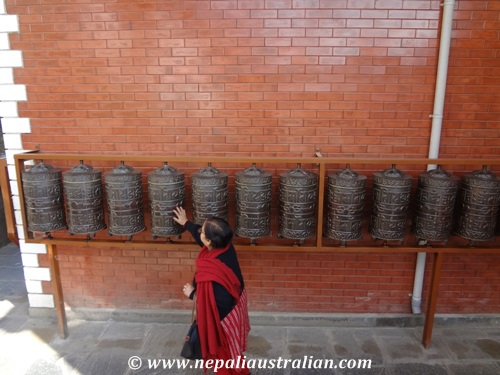
As we walk out from the monastery, there are prayer wheels all around it.  We rotated the prayer wheels and walked around the monastery. A prayer wheel is a cylindrical “wheel” on a spindle made from metal, wood, stone, leather or coarse cotton. Traditionally, the mantra Om Mani Padme Hum is written in Sanskrit on the outside of the wheel. According to the lineage texts on prayer wheels, prayer wheels are used to accumulate wisdom and merit (good karma) and to purify negativities (bad karma).

namo buddha  (15)

From the monastery, we walked to towards the top of the hill. There is a big statue of the Buddha at one place made out of brass.

namo buddha  (16)

As we walked towards the top of the hill, we reached a stone sculpture that depicted Buddha himself feeding a hungry tigress and her cubs. It is believed that the place is where Buddha gave up his body.

namo buddha  (8) namo buddha  (9)

namo buddha  (10)

Following the ridge to another summit on the same hill, there is another small Stupa which is said to be the spot of the den of the tigress. There, we saw pilgrims lying down on the ground as if offering their bodies to the place. Pieces of cloth hung on the branches of the tree for protection. It was such a beautiful place to be at.

namo buddha  (13) namo buddha  (11)

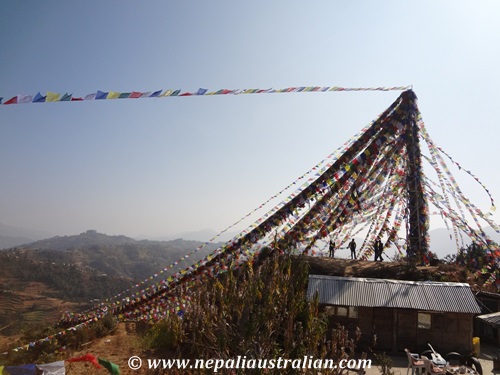
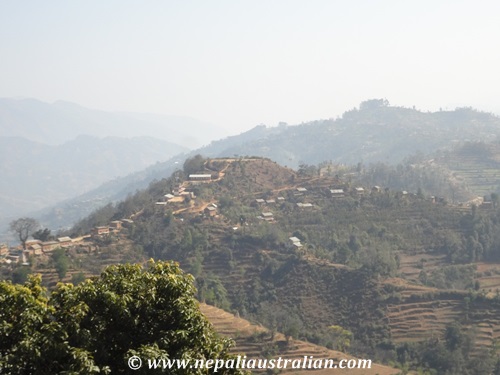
When we reached the top of the hill, we could see the monastery and the view of the village. On one side we could even see some part of the Karve District forest. The top of the hill is surrounded by colourful prayer flags and there were a few people enjoying their picnic around the area.

namo buddha  (12) namo buddha  (20) namo buddha  (6)

I really liked this side of Kathmandu and it will be a great place for anyone to go for a day or more to enjoy the peace you can find so close to busy Kathmandu.

Till next post, take care!

M from nepaliaustralia

XOXO

P.S.: I am going to Bryan Adams concert tonight and very excited. I will update more soon. Happy weekend everyone!!!

You may also like:

*Manakamana Temple *Cheers to new year 2070 *Zoo visit in Nepal