This article was published in +977 (a Nepalese Lifestyle Magazine in Australia) in August-September 2013 issue.
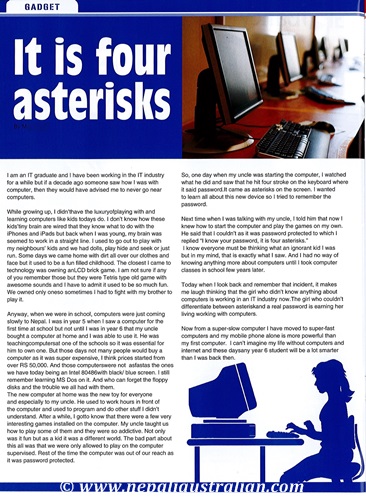
I am an IT graduate and I have been working in the IT industry for a while but if a decade ago someone saw how I was with computer, then they would have advised me to never go near computers.
While growing up, I didn’t have the luxury of playing with and learning computers like kids todays do. I don’t know how these kids’ tiny brain are wired that they know what to do with the iPhones and iPads but back when I was young, my brain was seemed to work in a straight line. I used to go out to play with my neighbours’ kids and we had dolls, play hide and seek or just run. Some days we came home with dirt all over our clothes and face but it used to be a fun filled childhood. The closest I came to technology was owning an LCD brick game. I am not sure if any of you remember those but they were Tetris type old game with awesome sounds and I have to admit it used to be so much fun. We owned only one so sometimes I had to fight with my brother to play it.
Anyway, when we were in school, computers were just coming slowly to Nepal. I was in year 5 when I saw a computer for the first time at school but not until I was in year 6 that my uncle bought a computer at home and I was able to use it. He was teaching computers at one of the schools so it was essential for him to own one. But those days not many people would buy a computer as it was super expensive, I think prices started from over RS 50,000. And those computers were not as fast as the ones we have today being an Intel 80486 with black/ blue screen. I still remember learning MS Dos on it. And who can forget the floppy disks and the trouble we all had with them.
The new computer at home was the new toy for everyone and especially to my uncle. He used to work hours in front of the computer and used to program and do other stuff I didn’t understand. After a while, I got to know that there were a few very interesting games installed on the computer. My uncle taught us how to play some of them and they were so addictive. Not only was it fun but as a kid it was a different world. The bad part about this all was that we were only allowed to play on the computer supervised. Rest of the time the computer was out of our reach as it was password protected.
So, one day when my uncle was starting the computer, I watched what he did and saw that he hit four stroke on the keyboard where it said password. It came as asterisks on the screen. I wanted to learn all about this new device so I tried to remember the password.
Next time when I was talking with my uncle, I told him that now I knew how to start the computer and play the games on my own. He said that I couldn’t as it was password protected to which I replied “I know your password, it is four asterisks.”
I know everyone must be thinking what an ignorant kid I was but in my mind, that is exactly what I saw. And I had no way of knowing anything more about computers until I took computer classes in school few years later.
Today when I look back and remember that incident, it makes me laugh thinking that the girl who didn’t know anything about computers is working in an IT industry now. The girl who couldn’t differentiate between asterisk and a real password is earning her living working with computers.
Now from a super-slow computer I have moved to super-fast computers and my mobile phone alone is more powerful than my first computer. I can’t imagine my life without computers and internet and these days any year 6 student will be a lot smarter than I was back then.
Join me to celebrate nepaliaustralians’ birthday as it is two years old today.
So many amazing things have happened in the past years because of this blog. Starting a blog was one of the best things I’ve ever done. This little blog has documented so many moments and thoughts of mine over the last two years that I am incredibly thankful to have a little space in this corner of the internet. For me this space has and will always be a place where I can write and ramble to my heart’s content. Over the years I’ve found that with age, my memory fades and the words and photos here bring back to life little moments that would have been otherwise forgotten.
When I started this blog two years ago, I never thought I would last more than a couple of months. I was just writing to share my stories but was not sure anyone would ever read it so thank you to everyone for all the support that you have provided and now I am determined not to quit this blog for a long time to come.
Thank you for reading, thank you for caring, thank you for commenting, thank you for helping make this blog something I love writing. This blog has given me many good friends and I wanted to say thank you to all of you for your love and support along the way. I have the greatest readers, I really do and I am so appreciative of this great blogging community.
I can’t believe I have written 507 posts, 59 pages, have 5277 comments with 321,030 page views and 2218 followers today as well as people from more than 206 countries visiting my blog!
Thank you Thank you Thank you!!!
I have a virtual cake for all to hand around! Cheers!!!
P.S: To celebrate the occasion, I have decided to start a Nepaliaustralian’s Blog Award so watch out for my next post.
Bhatmas is Nepalese for soya beans and this is one of the easiest and quickest recipes.
Ingredients
100gm bhatmas (dried Soya beans)
1 finely chopped green chili
1 tablespoon finely chopped ginger
1 tablespoon finely chopped garlic
1 teaspoon red chili powder
1 teaspoon oil
Salt as per taste
Method
Fry soybeans (with oil or without oil) in a pan until the beans are cook. Soybeans is cooked when the cover started to brown, take it off the heat and let it cool.
Add ginger, garlic, green chilli, salt and red chili powder. Mix well.
Remember a while ago, I talked about Mustang made it to Lonely Planets Best in Travel 2013 List. Today I read this on Mail Online and I have to share this with you all. If you are still questioning, if you have to go to Nepal, here is why I say you must.
Mystery: Thousands of man-made caves 155ft from the ground lie hidden within the Himilayas in a gorge so large it dwarfs the Grand Canyon
Bizarre: With dozens of holes carved into the fragile, sandy-coloured cliff face this unusual ‘neighbourhood in the sky’ looks like a giant sandcastle
Dangerous: Climber Cedar Wright explores the series of caves near the village of Tsele
Mystery of the ancient kingdom discovered in Nepal where thousands of caves are carved 155ft off the ground. An estimated 10,000 of the caves have been found in the former Kingdom of Mustang in North, Central Nepal. They have either been dug into the cliffside or tunnelled from above. Caves are thousands of years old but who built them and why remains a mystery.
Hidden within the Himalayas, 155ft from the ground, these man-made caves are one of the World’s greatest archaeological mysteries.Thousands of holes are carved into the fragile, sandy-coloured cliff in a gorge so large it dwarfs the Grand Canyon.
Adventure: Climbers and scientists follow a trail above the Kali Gandaki River
The astonishing number of caves, some dug into the cliffside, others tunnelled from above are thousands of years old but who built them and why remains a mystery.It is also not known how people climbed into the caves which are dug into a cliff 155-foot above the valley floor.
An estimated 10,000 of these mysterious human-built caves have been found in the former Kingdom of Mustang in North, Central Nepal. Those who have seen the mysterious caves say the effect of them on the cliff face makes it look like a giant sandcastle.
Adventure photographer, Cory Richards joined climber Pete Athans, archaeologist Mark Aldenderfer and a team of explorers to unearth the hidden relics of the ancient and remote caves. Mr Richards said: ‘I was in Nepal working in this village called Forte, where Pete [Athans] and I were teaching a group of Sherpas climbing techniques, safe climbing techniques so they could climb Everest. And Pete asked me if I would be interested in this project in Mustang. He started telling me about this place where we were going. The words he was using conjured these images of a place I couldn’t really imagine.
High up: Climber Pete Athans looks inside a cave found near Chuksang. It is not known how people climbed into the caves which are dug into a cliff 155foot above the valley floor
Quite honestly when I got there it was even bigger and more grand than anything I ever could ever have imagined. ‘We’re talking about somewhere that reminds us of the Grand Canyon, the desert south west but then has this incredible history to it. You see these caves carved into the rock and now they’re completely inaccessible.
As we started getting deeper into it, I started to see the magic of what we were approaching, the culture in practice, a 12th century village underneath the caves they used to live in, caves that are now forgotten. We started asking questions about how did people get into them?
Impressive: This image shows eroded murals on the walls of the Ritseling Cave in Upper Mustang. The astonishing number of caves are thousands of years old
I started wondering how do I light up people’s imagination to make them think what it would have looked like thousands of years ago, that was my final challenge, how do I give people that imagination.
One of the ways we did that was lighting up the caves, going them into them a night, spending the night in caves, using lights to light them up and strobes. Trying to give people the feeling this is a very ancient place, this is a place that has so many stories to tell us so much more than we can even really imagine in our lifetime.
Discovery: A scientist enters a maze of rooms in a looted cave near Chuksang, left, while another member of the team hoists himself up at a Mustang cave entrance, right
Climbing into the sky caves was no easy feat, the rock was unstable and posed a real danger to the team of explorers. In fact climbing into the caves was so dangerous, Mr Richards lost his footing, fell and broke his back. On another assignment to Mustang the following year, videographer Lincoln Else was hit by a falling rock, fracturing his skull.
He said: This was real exploration. It’s dangerous it’s loose rock it’s scary. Everything is loose, everything around you feels like it’s crumbling. You feel like when you’re climbing everything is going to collapse.
One of the things I think we forget when we’re talking about adventure, science and exploration is it gets dangerous at times one of the reasons it’s so exciting is because there are consequences and big consequences. On my first trip there I was trying to climb in and a foothold broke and I fell about 12-20 feet, I landed on my butt and I broke my back. It was an eye-opener because yes it this was really exciting, really engaging, I want to tell this big story but I just broke my back, maybe this isn’t as important as I thought.
Exploration: Members of the team do a preliminary survey of a cave
The next year we came back to try again. I took this shot and my friend Lincoln Else was filming right next to me. Next thing I heard was Pete’s wife scream, she said “oh my god, oh my god” Lincoln was lying on the ground with blood pouring from his head and convulsing.
A rock had fallen from above, hit him and given him a 21cm skull fracture, it completely depressed his skull. Again it was a point of realisation that yes what you are doing is very important but it’s also very dangerous and when you talk about adventure there are sides to it that are unpleasant.
Lincoln made a full recovery, I thought for certain I think we all thought at the point that Lincoln was going to die. Essentially at the end of the experience, what was illuminated to me the marriage of science and exploration and culture is the ultimate in how we bring the world to everyone.
‘We have to make it exciting, digestible but we also have to give the knowledge of what’s out there to everyone else.
























 nepaliaustralian