Category Archives: Nepal

BEHULI by Sanyukta Shrestha

If you haven’t heard about Sanyukta Shrestha before she is a London based Nepalese bridal wear designer who has been regarded as a fast rising star of the industry having been awarded The Best Perfect Wedding Newcomer Award 2011 & Bridal Innovation Award 2011.  She is the driving force behind the industry’s future as seen by the British media and the industry alike.

Born in Nepal, she has been awarded best designer several times in Nepal and international beauty pageants, since the year she started her design journey at the age of 17.  A graduate of London College of Fashion, she has worked in bridal and retail industry in the UK for 5 years before setting up her own label.  With her beautiful approach on ethical designs, she has brought a breath of fresh air, passion and distinct styling to the British bridal industry.

Her aim is for a new vision for bridal wear, one that combines an eco-friendly approach with the hand-crafted luxury, expected of the most desirable bridal collections & millinery; the whole collection is driven by a ‘LOVE GREEN-BELIEVE IN ETHICS’ ethos. Most of the natural fibres used in the bridal collections are skilfully hand spun and hand loomed by village women in Nepal.

Through blending sustainability with her ethical beliefs, Sanyukta intends to create opportunities for women in this area of the world, by merging and turning their traditional skills into delicate fabrics and exquisite designs. Sanyukta’s bridal collections goes beyond the one special occasion and are valued as collectable pieces of sustainably hand-made, hand woven and hand crafted products. From luxurious silk wedding gowns to exquisite bridal millinery each style within this collection follows ecologically green guidelines, with fabrics from ethical and fair trade certified manufacturers.

Sanyukta Shrestha’s launch of her first eponymous bridal collection in the 2011 White Gallery London created a stir in the wedding industry. Recognition for her work has come from features in leading magazines Conde Nast Brides, You and Your Wedding, Wedding UK, Perfect Wedding, Bridal Buyer, Attire Bridal and also from international press like Vogue Sposa, Sposa Bella and Fashion TV.

Sanyukta Shrestha couture wedding gown Pippa from 2013 collection has been now preserved in Fashion Museum, Bath as a unique piece of art.

She has also been honoured with Highly Commended Brand Leader in Design at Source Awards 2012, The Global Awards for Sustainable Fashion.

Sanyukta Shrestha collections are currently stocked in luxury Bridal Boutiques in England, Wales, Northern Ireland and the Republic of Ireland.

Recently Sanyukta Shrestha team hosted a launch event to introduce press and industry to the new flagship store ‘Behuli‘. Behuli means bride in Nepalese and I am so glad that she picked that name for her store showing her Nepalese heritage.

Behuli is an extension of Sanyukta’s ethos ‘Beauty with a conscience’ focusing on providing luxury bridal wear that is individual and ethical.

The event was attended by many notable people in bridal fashion industry from leading bridal Editors, Fashion directors & stylists, to wedding planners, Photographers & bridal boutiques owners.

I believe in individuality and I enjoy bringing out inner beauty, a reflection of personality of woman who wears my design. For me feeling good is equally important as looking good. My desire has been always to create beautiful designs that are luxurious, indulgent, individual and equally sustainable. Through following ecologically green guidelines for all our production process using only eco fabrics that are sourced from trusted suppliers and hand weaved through the traditional skills of Nepalese village women, we are trying to ensure that the whole creative process of our gowns is ethical and natural. It is ultimately all about creating ‘beauty with a conscience’.  – Sanyukta Shrestha

To know her better please read the following interview from myrepublica.com.

After the Best Wedding Newcomer Award 2011, Bridal Innovation Award 2011 and Highly Commended Brand Leader at the Source Award 2012, your wedding gown has now made it into The Fashion House. How do you feel?

“This is surely one of the happiest moments of my life as a designer. It’s so great to be recognized for doing work that you truly believe in. It is a wonderful feeling and I feel honored. It inspires and encourages me to work even harder to create better work.

What is SOURCE Awards and how important is this award for you?

The SOURCE Awards are Global Awards for Sustainable Fashion, which celebrate and focus the spotlight on the most innovative, inspirational businesses, individuals, and initiatives in the fashion industry, globally. This award is very special as it is dedicated to forward thinking fashion that aims to inspire and change the industry. It is an honor to be named Brand Leader as with all of our work we hope to encourage others as well to move towards sustainable fashion as a future plan.

You are a fast rising star in the bridal industry in the UK. How did you land up designing wedding dresses?

I find bridal the most intriguing part of the Fashion industry. In my whole design career, my desire was always to bring out the personality and individuality of every person who wears my design. To bring out the inner beauty of the bride on the most special day of her life is very fulfilling.

How big the wedding dress market is there and how are your dresses doing?

It’s a huge industry here in the UK. We are very lucky to be in the company of incredibly talented international and national designers who are working together for the industry. I still feel a little bit like Alice in the wonderland. However, it’s a journey that is challenging and inspiring me every day. Our brides are not just limited to UK and Ireland, awareness is growing gradually in surrounding European countries and Canada too.

Yours is a one of a kind sustainable bridal brand. How did you define sustainable fashion? And what are sustainable eco-friendly fabrics?

For me sustainable fashion is all about having heart, good thoughts and tying to do good deeds. In a simple word it’s a ‘fashion for humankind. ’ You have to think of every consequence, every choice that may affect people and our planet. Eco Fabrics are hemp, organic cotton, organic silk, soya, milk to name few.

Explain your ethos – ‘Love green – believe in ethics’.

The Love Green – Believe in Ethics ethos comes from the desire to create beautiful designs that are sustainable, eco friendly and hand crafted. Through using only eco fabrics that are sourced from trusted suppliers and hand weaved through the traditional skills of Nepalese village women we are trying to ensure that the whole creative process of our gowns is ethical and natural. It is ultimately all about creating ‘beauty with a conscience’.

How do you collect fabrics you use? Do you use Nepali fabrics also?

Most fabrics we use are from Nepal, like organic cotton, bamboo, silk, soya, Nettle, hemp etc. Some others are sourced locally in the UK. While new innovative technology fabrics like milk and bamboo silk lace comes from Italy.

How you do you feel owning your own label Sanyukta Shrestha?

Very happy and very privileged!

You started as an official designer in Miss Nepal in 1998? Do you have any plans to do something back home?

First collection I created was for Miss Nepal Beauty Pageant in 1998. Nepal has always been part of my design inspiration and the production process. Yes, I love to design for beautiful Nepalese women of all ages.

Pippa gown

The inspiration behind Pippa dress came to Sanyukta organically when she moved to new house. She explains, “I discovered these 30 years old of history caught up under the floorboards. Refusing to simply discard these pieces of antiquity I decided to aid another metamorphosis by reincarnating these aged papers into a dreamy romantic wedding dress for my collection that is inspired by Wallis Simpson.”

Including issues from the 1982 to 1983, from publications such as The Standard, The Daily Mail, Sunday Mail, The Weekly News, The Daily Express, The Sun and Motorcycle News, Pippa’s perfectly aged paper took the catwalk to truly represent the journey that any up-cycled product can take from ordinary to extraordinary. The Pippa gown gives new meaning to an old world style that takes the vintage to the next level. Aided by Nepalese hand loomed organic cotton and finished with nearly three thousand Swarovski Crystals to ensure that she really dazzles the world, the Pippa gown was launched at White gallery London Battersea Evolution, May 2012. With stunningly extravagant design and such an unusual history the finale of Pippa shocked and awed the audience. With the industry and press alike recognising Pippa as an incredible piece of art as well as statement on the importance of eco-friendly fashion the gown is unique, dramatic and showed a real story that gives a sense of history.

Source: http://www.sanyuktashrestha.com

You may also like:

*Prabal Gurung : A Fashion designer from Nepal *Varsha Thapa: First international fashion model from Nepal *Aastha Pokharel representing Nepal on Asia’s Next Top Model

How to piss off a Nepali?

I was reading this article on www.matadornetwork.com and was laughing whole way through as it is so true. I can’t help but share this with you all.

So you happen to come across this brown individual at a party or at the mall and you start making guesses about where he or she is from. The worst way you can start off your interaction is by asking them if they are from India. Not a “So, where are you from?” But a direct “Are you from India?”

You’ve learned how to piss off a Nepali already. Although an incredibly laid-back lot, we can at times be quite sensitive about people’s assumptions or understanding of our country, and our nationality. Being sandwiched between two massive cultures doesn’t help — many an ignorant soul thinks Nepali culture and ethnicity is purely a mix of Indian and Chinese.

Here are a few more things you can say to further piss off someone from Nepal.

“Where is that?”

Just because you suck at geography, we have to go through a list of ‘Did you know?’ facts about our country to give you a sense of where in the world it is. If you know Mt. Everest, you should have probably put in the effort to look up where it is.

The point is that when it comes to our country and our nationality, Nepali people are, in general, a proud bunch. And when you tell us you haven’t even heard of the place or don’t know where it is, you’re bound to incite a frown or two.

“Oh Naples, of course!”

If you want to go one level higher, this would be the jackpot. Fake that you know what you’re talking about and then burst that bubble by telling us you know of a city that’s not even one of the best known in Europe, and think that it’s actually a country.

“Oh so you must have climbed Everest.”

Yes, Everest is in Nepal, but not in my backyard. And not all of us are Sherpas. In addition, it takes years of training and around $50k to ascend the highest mountain in the world.

In fact, a good number of Nepali people have never even seen Everest (thanks to the number of other massive Himalayan mountains that block our view), let alone climbed it. Would you assume someone from France or Italy must have summited Mont Blanc?

“So you speak Indian.”

Hindi, you mean. It’s called Hindi. And no, we speak Nepali because we’re from Nepal. The two are different languages even though they use the same script. English and German aren’t the same language just because they use the same alphabet, now are they?

“Buddha was from India.”

It’s a matter of grave distress to Nepali people when you mistakenly proclaim that Buddha was born in India. Yes, he did gain enlightenment and did most of his important work in India. But don’t make us take out the history books, or demand that you go to Lumbini in southern Nepal to visit the birthplace of the Enlightened One.

“So, you’re Buddhist.”

Over 80% of the population of Nepal is Hindu; only around 10% are Buddhist. But we might give you the benefit of the doubt on this one, because Buddhism and Hinduism are essentially the same religion in Nepal. Gautam Buddha was Hindu himself and is considered an incarnation of the Hindu god Vishnu.

“Momos…aren’t they the same as Chinese or Japanese dumplings?”

No! Dumplings may have been invented somewhere in the Far East. They might have come into Nepal through Tibet in the north. But they were perfected in Nepal and they are called momos. We will not even consider anything else for an answer.

These out-of-this-world delicious dumplings come with a sauce that’s even better and can be found basically anywhere you go in Nepal. Try them and your taste buds will be caressed by the rich flavors of the momos till all your tongue wants is more momos.

“It must be freezing over there.”

Yes, we’re situated among the Himalayas. But not all of Nepal lives at extreme altitudes. The southern parts of the country are as low as 300ft above sea level and can get plenty hot.

You’re gonna look pretty dumb in your winter coat on the back of an elephant in Chitwan National Park.

You may also like:

* *Etiquette for travelling like a local *Mystery of the ancient kingdom discovered in Nepal

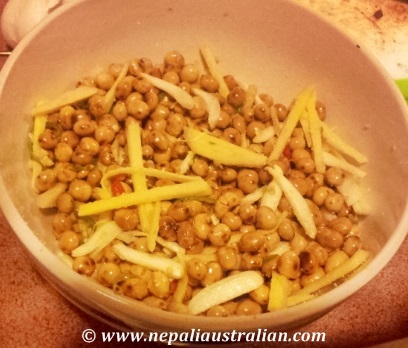
Bhatmas Sandeko

Bhatmas is Nepalese for soya beans and this is one of the easiest and quickest recipes.

Ingredients

  •  100gm bhatmas (dried Soya beans)
  • 1 finely chopped green chili
  • 1 tablespoon finely chopped ginger
  • 1 tablespoon finely chopped garlic
  • 1 teaspoon red chili powder
  • 1 teaspoon oil
  • Salt as per taste

Method

  • Fry soybeans (with oil or without oil) in a pan until the beans are cook. Soybeans is cooked when the cover started to brown, take it off the heat and let it cool.

batmas (1)

  • Add ginger, garlic, green chilli, salt and red chili powder. Mix well.

batmas (2)

  • Bhatmas sadeko is ready to be serve.

You may also like:

*Seviya kheer (vermicelli kheer) *Kheer(Rice pudding) *Gundruk Aloo Bhatmas Curry

Mystery of the ancient kingdom discovered in Nepal

Remember a while ago, I talked about Mustang made it to Lonely Planets Best in Travel 2013 List. Today I read this on Mail Online and I have to share this with you all. If you are still questioning, if you have to go to Nepal, here is why I say you must.

Mystery: Thousands of man-made caves 155ft from the ground lie hidden within the Himilayas in a gorge so large it dwarfs the Grand Canyon

Bizarre: With dozens of holes carved into the fragile, sandy-coloured cliff face this unusual ‘neighbourhood in the sky’ looks like a giant sandcastle

Dangerous: Climber Cedar Wright explores the series of caves near the village of Tsele

Mystery of the ancient kingdom discovered in Nepal where thousands of caves are carved 155ft off the ground.  An estimated 10,000 of the caves have been found in the former Kingdom of Mustang in North, Central Nepal. They have either been dug into the cliffside or tunnelled from above.    Caves are thousands of years old but who built them and why remains a mystery.

Hidden within the Himalayas, 155ft from the ground, these man-made caves are one of the World’s greatest archaeological mysteries.Thousands of holes are carved into the fragile, sandy-coloured cliff in a gorge so large it dwarfs the Grand Canyon.

Adventure: Climbers and scientists follow a trail above the Kali Gandaki River

The astonishing number of caves, some dug into the cliffside, others tunnelled from above are thousands of years old but who built them and why remains a mystery.It is also not known how people climbed into the caves which are dug into a cliff 155-foot above the valley floor.

An estimated 10,000 of these mysterious human-built caves have been found in the former Kingdom of Mustang in North, Central Nepal. Those who have seen the mysterious caves say the effect of them on the cliff face makes it look like a giant sandcastle.

Adventure photographer, Cory Richards joined climber Pete Athans, archaeologist Mark Aldenderfer and a team of explorers to unearth the hidden relics of the ancient and remote caves. Mr Richards said: ‘I was in Nepal working in this village called Forte, where Pete [Athans] and I were teaching a group of Sherpas climbing techniques, safe climbing techniques so they could climb Everest. And Pete asked me if I would be interested in this project in Mustang. He started telling me about this place where we were going. The words he was using conjured these images of a place I couldn’t really imagine.

High up: Climber Pete Athans looks inside a cave found near Chuksang. It is not known how people climbed into the caves which are dug into a cliff 155foot above the valley floor

Quite honestly when I got there it was even bigger and more grand than anything I ever could ever have imagined. ‘We’re talking about somewhere that reminds us of the Grand Canyon, the desert south west but then has this incredible history to it. You see these caves carved into the rock and now they’re completely inaccessible.

As we started getting deeper into it, I started to see the magic of what we were approaching, the culture in practice, a 12th century village underneath the caves they used to live in, caves that are now forgotten. We started asking questions about how did people get into them?

Impressive: This image shows eroded murals on the walls of the Ritseling Cave in Upper Mustang. The astonishing number of caves are thousands of years old

I started wondering how do I light up people’s imagination to make them think what it would have looked like thousands of years ago, that was my final challenge, how do I give people that imagination.

One of the ways we did that was lighting up the caves, going them into them a night, spending the night in caves, using lights to light them up and strobes. Trying to give people the feeling this is a very ancient place, this is a place that has so many stories to tell us so much more than we can even really imagine in our lifetime.

Discovery: A scientist enters a maze of rooms in a looted cave near Chuksang, left, while another member of the team hoists himself up at a Mustang cave entrance, right

Climbing into the sky caves was no easy feat, the rock was unstable and posed a real danger to the team of explorers. In fact climbing into the caves was so dangerous, Mr Richards lost his footing, fell and broke his back. On another assignment to Mustang the following year, videographer Lincoln Else was hit by a falling rock, fracturing his skull.

He said: This was real exploration. It’s dangerous it’s loose rock it’s scary. Everything is loose, everything around you feels like it’s crumbling. You feel like when you’re climbing everything is going to collapse.

One of the things I think we forget when we’re talking about adventure, science and exploration is it gets dangerous at times one of the reasons it’s so exciting is because there are consequences and big consequences. On my first trip there I was trying to climb in and a foothold broke and I fell about 12-20 feet, I landed on my butt and I broke my back. It was an eye-opener because yes it this was really exciting, really engaging, I want to tell this big story but I just broke my back, maybe this isn’t as important as I thought.

Exploration: Members of the team do a preliminary survey of a cave

The next year we came back to try again. I took this shot and my friend Lincoln Else was filming right next to me. Next thing I heard was Pete’s wife scream, she said “oh my god, oh my god” Lincoln was lying on the ground with blood pouring from his head and convulsing.

A rock had fallen from above, hit him and given him a 21cm skull fracture, it completely depressed his skull. Again it was a point of realisation that yes what you are doing is very important but it’s also very dangerous and when you talk about adventure there are sides to it that are unpleasant.

Lincoln made a full recovery, I thought for certain I think we all thought at the point that Lincoln was going to die. Essentially at the end of the experience, what was illuminated to me the marriage of science and exploration and culture is the ultimate in how we bring the world to everyone.

‘We have to make it exciting, digestible but we also have to give the knowledge of what’s out there to everyone else.

You may also like:

* *Etiquette for travelling like a local *Zoo visit in Nepal

In love with Prabal Gurung Spring 2014 New York Fashion Show

My favourite designer Prabal Gurung is out with his Spring 2014 New York Fashion Show collection. I am in love with his collection in pastel colours, abstract florals, sheer mesh panelling and couture flourishes. Staged in an industrial hall in the cavernous space of Moynihan station, the show started with models lining behind the clear curtain giving audience time to look at the amazing collection in detail.

The designer explains the idea behind his Plastic Cage-Like Runway Show. “Basically, it’s celebrating the preservation of an elegant woman, which has become a source of inspiration and intrigue for me for the longest time. The idea of preservation came from couture fabrics—to modernize it, to use plastic, to lacquer it,” Gurung told InStyle.com. “The whole thing started with Bert Stern’s picture of Marilyn Monroe‘s last sitting. She’s the idealized woman. There was something so beautiful and so melancholic about (the picture), and I wanted to create that.” And that he did, bringing femininity into a modern context through the clothes, jewelry and even shoes.

I am loving the shirtdresses, halter blouses, curve-hugging midi-skirts, sweetheart neckline wiggle dresses and tulip jackets.

Here are some of my favorites from the collection.

 I also loved matte shades lips, perfect hair, colorblocked cat-eye sunglasses  but the highlight for me is definitely the amazing collection of pointed-toe slingbacks. I really want them now.

It was a celebration of women,” he said, backstage after the show. “I was thinking about preserving elegance, but making it modern and right for now – and with the right amount of danger . I wanted to abstract and modernize this idea of an idealized woman, For me, it’s someone who’s colorful, bold, and unafraid of her curves—really being feminine and appreciating that. Sensual, but with a hint of danger”

Here are some reviews for his collection.

Vouge magazine : “ Technically, too, this was Prabal Gurung’s best collection to date.

British Vouge :”I like the idea of femininity with bite,” he smiled. We do too.”

Women wear daily: “The evening dresses were the real highlight, with Gurung turning down the sporty effects to let the glamour glow. True to his word, he layered harnesses under the dresses and gowns, many done in thick, colourful satin wrapped around the body or corseted and spliced with mesh on tea-length dresses. A black silk duchesse dress, cut off the shoulder and embroidered with big crystal rosettes, was just about perfect.”

fashionista.com : “Prabal Gurung’s spring 2014 show was an experience–one that made use of all of our senses. It was risky collection, unlike anything we’ve seen thus far this week, as Gurung proved yet again why he’s one of New York’s biggest stars.”

You may also like :

*Sneak peak on Prabal Gurung for Target *Love you, Prabal Gurung *Over the moon to get the Prabal Gurung parcel